About the National Parents Union
https://nationalparentsunion.org/
The National Parents Union (NPU) is a network of highly eƦective parent organizations and grassroots activists across the country that is united behind a set of common goals and principles to channel the power of parents. Our family advocates improve the quality of life for children across the United States and define the education conversation.
NPU unites parents of color, low-income parents, special needs parents, single mothers and fathers, grandparents, formerly incarcerated parents and parents in recovery with traditionally represented parent voices to join a vibrant coalition that disrupts the traditional role of parent voice in policy space. It develops a new narrative that is inclusive of families from a wide variety of perspectives.
It is time to forge a path forward to create space to put education at the top of the list of our national priorities. Parents and families have the power to change the conversation and politics around education reform and innovation. This is the national parent movement to build the change needed in national education policy conversations to create the change we need for our families.
Our mission is to support parents who have lived experience and are authentic voices, advocates and organizers who are engaging, educating and empowering families, neighborhood by neighborhood across the United States.
About the Lead Author
Christina Laster is a fierce and relentless advocate
for children and families in our education system.
Christina is a charter school parent and grandparent and currently serves as the Director of Policy and Legislation with National Parents Union (NPU), a Practitioner of Stanford University's Hoover Institution - HESI Council, the Western Regional Education Advisor & Liaison with the National Action Network, and a Director on the Board of Trustees at Aspire Public Schools.
She began her education work in California, spending nearly 13 years in the San Diego Unified School District-Early Childhood and Special Education Program OƧces. She formerly served as Statewide Community Organizer for the California Policy Center and as local NAACP Education Chair.
With an academic background in Political Science and Business Administration, a track record of advocacy on civil rights issues, and a deep understanding of grassroots-community organizing, Christina empowers families to advocate for learning justice. She elevates authentic family voices through articles and podcasts and now dedicates her life to training families in attacking persistent racial disparities in education. In her roles, she works alongside families and local leaders in underserved and vulnerable communities, zealously advocating for quality schools.
About NPU’s Policy Committee
The mission of the National Parents Union Policy Committee is to fully equip and position parents in power to impact policy decisions and influence legislative changes for K-12 Education.
The National Parents Union Policy Committee develops and informs the National Parents Union Parent Power Agenda (our yearly policy priorities and areas of concentration) and the National Parents Union Legislative Agenda (our yearly legislative priorities). In addition, the NPU Policy Committee provides rapid response recommendations to emerging policy and legislative issues that present outside of the standard PPA or LA to meet the needs of parents and families on the ground. The goal of this group is to provide direct guidance and recommendations to ensure inclusion of intersectional, grassroots perspectives to help inform decision making by the leadership of the National Parents Union.
Parents have been fighting for a seat, even resorting to bringing their own chairs, to be at the table where decisions are made for our children. We have been doing this only to find that the table is already full, or has been folded and put away. Committed to the promise of changing the status quo, the National Parents Union is partnering with other national organizations to demand a high quality public education by any means necessary. It has become clear that change is not going to come from the goodwill or desire of educational systems to do right by our children. The National Parents Union is working with elected oƧcials, other national organizations, policy strategists and practitioners to transform public education through legislation. Instead of reacting to proposed legislation, parents from the National Parents Union are finally an integral voice while crafting language that will be presented to lawmakers.
This opportunity is providing representatives from the National Parents Union Policy Council a first row seat in the legislative process from beginning to end. This arms parents with the ability to lead legislative change on a local and statewide level. While there is an immediate and timely project, this is work that needs to be continued beyond this year’s budget cycle and national elections.
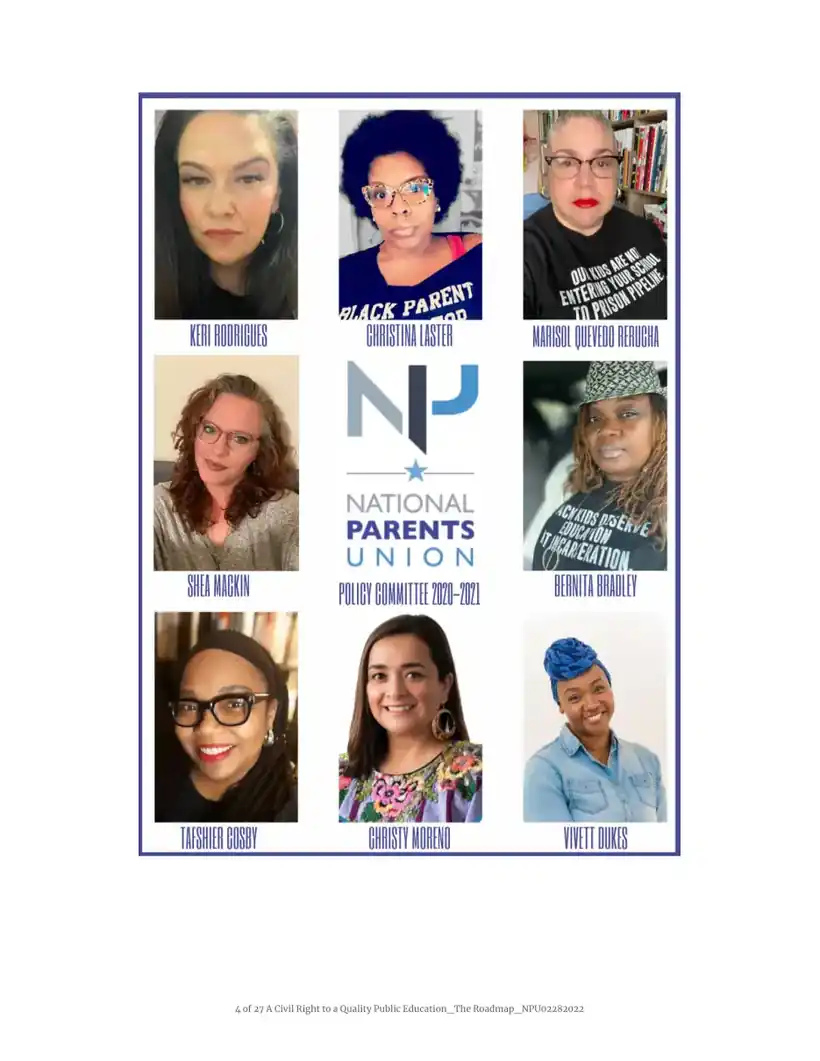
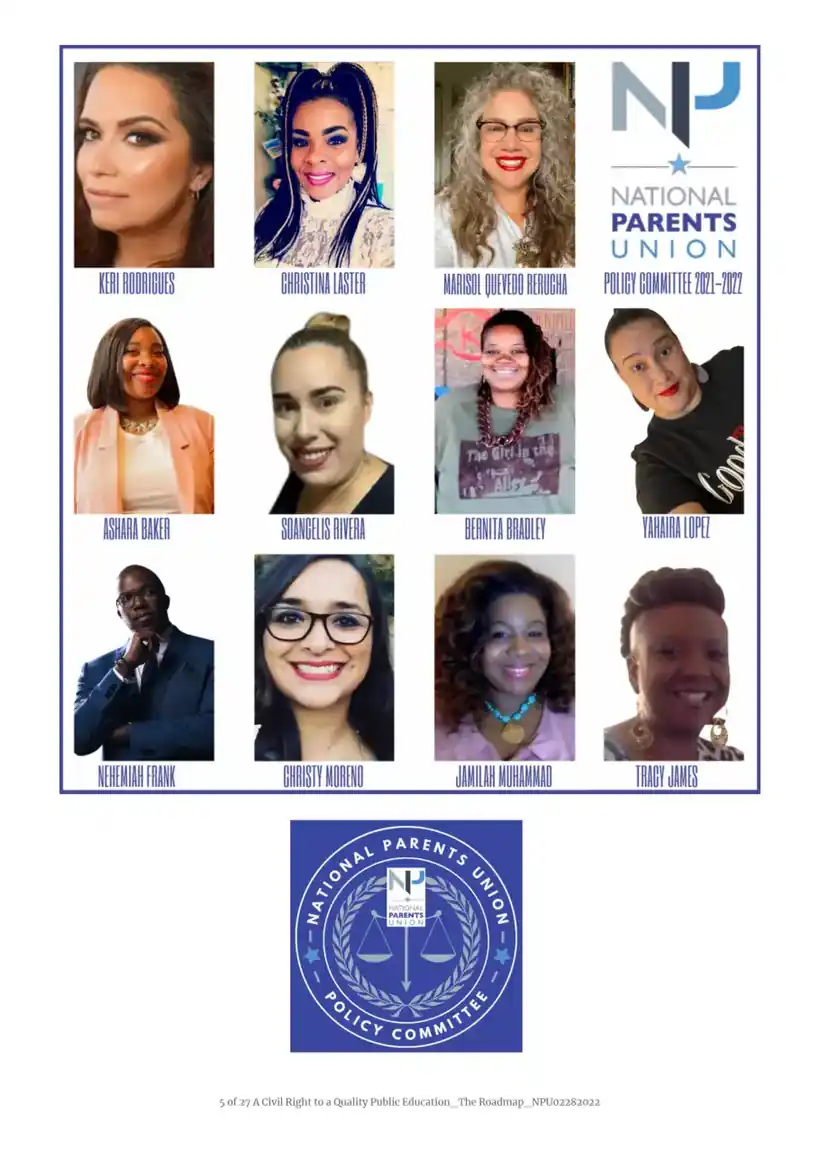
Table of Contents
Section 1 - Executive Summary……………………………………………………….pg 7
Section 2 - The Challenge………………………………………………………………..pg 9
Section 3 - Overview………………………………………………………………………..pg 11
Section 4 - The Roadmap………………………………………………………………..pg 16
Section 5 - Conclusion……………………………………………………………………..pg 22
Section 6 - Call to Action………………………………………………………………….pg 23
Section 7 - Glossary of Draft Terms…………………….………………………….pg 24
Section 8 - National Parents Union Polling…………………………………….pg 25
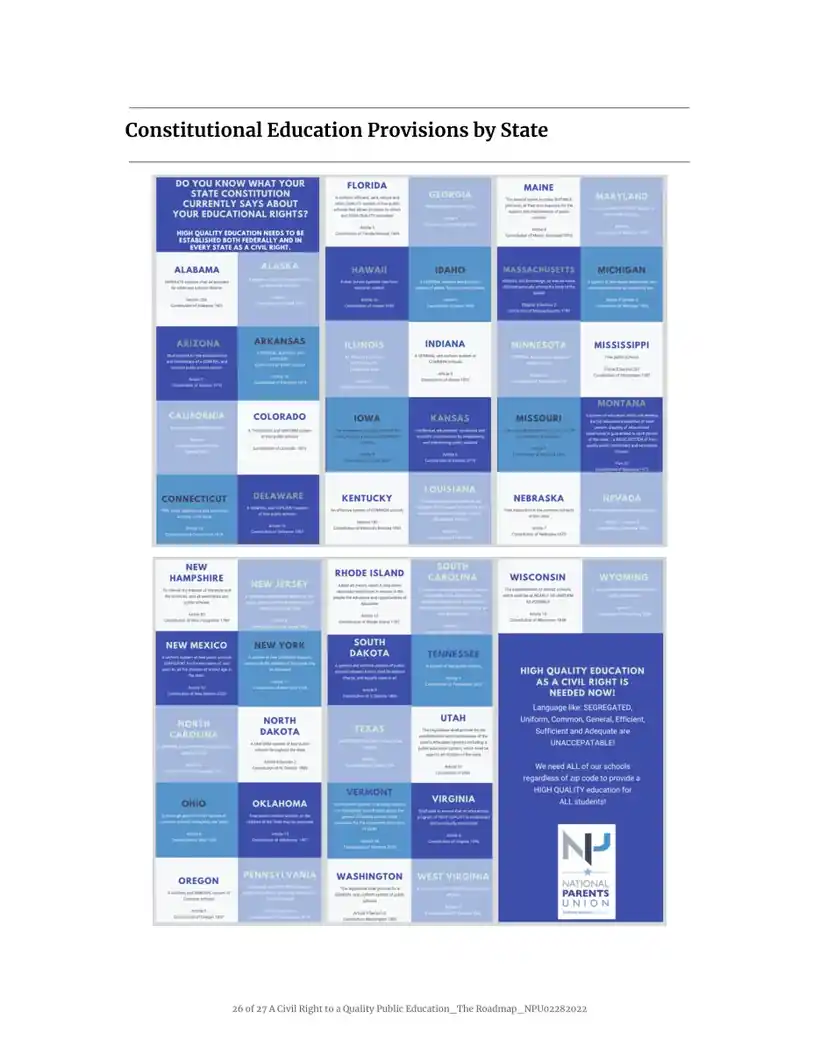
Section 9 - Constitutional Education Provisions by State……………..pg 26
Section 10 - Acknowledgements……………………………………………………….pg 27
Executive Summary
How do we create a fundamental right to a quality public education?
A constantly increasing national coalition of parents, activists, legal experts, advocates, community leaders, parent groups, and civil rights organizations are addressing this question by bridging the gap between law, policy, and organizing to create a fundamental or civil right to a quality public education. Currently very limited constitutional guarantees exist and many State’s constitutions give bare minimum standards about theoƦer of a free public education. The troubling fact is that education is mentioned in their constitutions but described in terms such as free, uniform, basic, or adequate. These vague and ambiguous descriptions leave way too much power and authority about K-12 Educational decisions to the interpretation of Statesmen and seem to ignore the realities and experiences of families.
Uniform, basic, and adequate come up short when decisions need to be made that put the interests of children first. They do not give a clear line of sight about what rights, if any, the parents have to advocate for better. Our experiences with the K-12 Education system have noted that inputs and outputs do matter, but the outcomes produced by having low or no minimum baseline standard as the fundamental guarantee to an education, have left generations of students hanging in the balance and parents out in the cold.
Parents are the most credible source of information about their children and it is way past time to acknowledge that K-12 Education decisions cannot be made in a vacuum and absent parent voice. This recognition led us to create a theory of change around a set of fundamental principles needed to be established in order to disrupt the traditional way K-12 Education decisions are made. Our shared experiences and perspectives included throughout this process promotes the value of parent voice and puts the interests of children first in educational decision making processes.
Recognizing the vast and persistent failure of the system to produce high measurable outcomes, calculating the system’s inputs and outputs, utilizing a constitutional framework, assessing existing K-12 Education codes and regulations, not finding structures that systematically provide oversight and accountability, acknowledging the role parents and community organizers play in the educational community, joining legal experts in evaluating existing rights, while understanding that the persistent issues in K-12 Education require parents to have a seat at any decision making table; we decided that it is way past time to realize a fundamental or civil right to a quality public education.
This roadmap explains the intense process parents and grandparents in coalition with others undertook to find ways of creating a fundamental right to a quality public education that puts the interests of their students first.
The Challenge
Based on our perspectives and experiences: The United States K-12 Education system perpetuates a vicious cycle of cumulative disadvantage experienced by racialized and racially minoritized groups. Black, Brown, Indigenous, and poor children continue to face opportunity gaps and disparate outcomes which influence their quality of life and chances at upward mobility. As these groups have historically battled against educational injustices and inequalities, they have been met with adversity in their attempts to disrupt continual cycles of generational institutional racism and an entrenched status-quo that has become too comfortable with the lackluster outcomes the American education system produces. Parents have equally been met with a lack of value and respect when advocating for a quality education for their children, leaving them disassociated and disenfranchised from decision making processes. At the same time, these same Parents are forced to deal with the consequences of these outcomes as their children are left ill-prepared to take college level courses once accepted to post-secondary institutions or attempt to enter the workforce, setting another generation up to repeat a seemingly unending cycle of poverty perpetuated by these dismal outcomes.
Accountability movements of the Elementary and Secondary Education act such as that of No Child Left Behind and Every Student Succeeds have not been able to provide the levels of accountability measures and structures to produce quality academic outcomes. In fact, the link between average academic outcomes to racial and/or socio-economic identities in the U.S, indicates a protected practice of oppression, discrimimation, and inequality by way of the K-12 Education system.
Narratives and rhetoric about achievement gaps have done little to solve the overall issue of the gaps. These narratives take the accountability focus away from the system and center them around what is taking place with the groups themselves. Policy responses have been similar, instead of focusing on how to improve opportunity gaps and ameliorate the cycles of cumulative disadvantages, policies have historically produced practices that further exacerbate gaps and don’t put the interests of all children first.
States have been able to set low goals and produce low outcomes with impunity. Without actionable legal protections for parents and communities to fight back, inadequate yearly progress rates, low measurable outcomes, and inappropriate monitoring techniques, will continue without real consequences. Local state and federal policy makers, administrators and elected oƧcials will continue to produce minimal progress with dismal outcomes on behalf of our children because of a lack of accountability measures and their inability to prioritize the transformation, modernization and reimagining of our K-12 education systems.
Noting the absence of real consequences for low outcomes, frustrated at the blame game, deceptive political rhetoric and the manipulation of messaging around parent and family frustrations with the existing status quo, the National Parents Union sought to fully realize the promise of equality for their children and mobilize Parent advocates to pursue educational justice.
From a legal perspective, Parents have found reviewing their State’s constitutions and evaluating their existing rights as frustrating and disappointing. Most states fail to guarantee any true quality of a school aged child’s education and are in dire need of robust changes through a constitutional amendment process. Establishing a fundamental right to a quality education is a path forward in expanding opportunities and improving outcomes by making a failure to demonstrate these outcomes an actionable oƦense.
This heavy lift cannot be done by Parents alone and must happen in coalition with others who are willing to meet this moment with urgency, innovation and courage. Bridging this gap between law and organizing is essential if we are to pave a generational path forward in K-12 Education that puts the interests of children at the center.
The Overview
Most Parents don’t expect to have to become instant experts about law and politics when they enroll their children in school. Black, Brown, Indigenous, and poor Parents enter their children in the K-12 Education system only to discover that when they exit, they have been deeply traumatized by the Belief Gap racism and bullying, ill prepared by a lack of rigorous curriculum and handed a diploma that means little to nothing when it comes to being adequately prepared for college or entering the workforce. . Many Parents find out that lack of knowledge and expertise in areas of law and politics put them at a disadvantage for advocating about their child’s education. For generations, it was assumed by many that schools want to educate and develop a child to reach their fullest potential. Yet the data pointing to outcomes show the education system is nefarious and the systemic failure of our education system during the COVID-19 pandemic has awoken a great movement of Parents and families who are more engaged now than ever before.
But the disenfranchisement of parents advocating for better quality education has been a long standing tradition in the United States and is not by accident but by systemic design. The quest for a quality education for
Black, Brown, Indigenous, and poor parents has always been one of struggle and met with fierce opposition.
While some parents may realize the vast number of cases highlighting the battles faced by Black, Brown, Indigenous, and poor families throughout the history of U.S K-12 Education, NPU’s Policy Committee focused studies around 3: Mendez v. Westminster, Brown v. Board of Education, and San Antonio Independent School District v. Rodriguez.
Mendez v. Westminster preceded Brown v. Board of Education, making California the first state to oƧcially desegregate its public schools. In the U.S District Court Decision Judge McCormick wrote:
"'[t]he equal protection of the laws pertaining to the public school system in California is not provided by furnishing in separate schools the same technical facilities, textbooks and courses of instruction to children of Mexican ancestry that are available to the other public school children regardless of their ancestry. A paramount requisite in the American system of public education is social equality. It must be open to all children by unified school association regardless of lineage.1"
Thurgood Marshall who represented Sylvia Mendez, five years later represented Brown in the Brown v. Board of Education of Topeka. It is important to note in these cases that social science evidence was used to relay the degradation and harm caused by a system that refused to oƦer Black and Brown children the right to an equally protected education as that of their white counterparts. Illustrating this is Harry Briggs, Jr., etal. v. R.W. Elliott, etal. consolidated under Brown v. Board, Judge Waites Waring’s Dissenting Opinion:
“These [social scientists] testified as to their study and researches and their actual tests with children of varying ages and they showed that the humiliation and disgrace of being set aside and segregated as unfit to associate with others of diƦerent color had an evil and ineradicable eƦect upon the mental processes of our young which would remain with them and deform their view on life until and throughout their maturity....They showed beyond a doubt that the evils of segregation and color prejudice come from early training...it is diƧcult and nearly impossible to change and eradicate these early prejudices however strong may be the appeal to reason…if segregation is wrong then the place to stop it is in the first grade and not in graduate colleges.2”
The Brown v. Board case was celebrated as a legal turning point for Black people in America and a Civil Rights victory. Overturning the "separate but equal" doctrine first articulated in the Plessy v. Ferguson decision of 1896, proved not to be suƧcient in creating the systemic changes that the parents and community had hoped for.
By the time San Antonio Independent School District v. Rodriguez was argued in 1972, Thurgood Marshall, who had originally been foundational in winning the desegregation cases of Mendez and Brown, was positioned as an Associate Justice of the Supreme Court. San Antonio Independent School District v. Rodriguez essentially dismantled and overturned the Brown win and Marshall had this to say:
“The Court today decides, in eƦect, that a State may constitutionally vary the quality of education which it oƦers its children in accordance with the amount of taxable wealth located in the school districts within which they reside. The majority's decision represents an abrupt departure from the mainstream of recent state and federal court decisions concerning the unconstitutionality of state educational financing schemes dependent upon taxable local wealth. More unfortunately, though, the [411 U.S. 1, 71] majority's holding can only be seen as a retreat from our historic commitment to equality of educational opportunity and as unsupportable acquiescence in a system which deprives children in their earliest years of the chance to reach their full potential as citizens. The Court does this despite the absence of any substantial justification for a scheme which arbitrarily channels educational resources in accordance with the fortuity of the amount of taxable wealth within each district.
In my judgment, the right of every American to an equal start in life, so far as the provision of a state service as important as education is concerned, is far too vital to permit state discrimination on grounds as tenuous as those presented by this record. Nor can I accept the notion that it is suƧcient to remit these appellees to the vagaries of the political process which, contrary to the majority's suggestion, has proved singularly unsuited to the task of providing a remedy for this discrimination. I, for one, am unsatisfied with the hope of an ultimate ‘political’ solution sometime in the indefinite future while, in the meantime, countless children unjustifiably receive inferior educations that ‘may aƦect their hearts [411 U.S. 1, 72] and minds in a way unlikely ever to be undone.’ Brown v. Board of Education, 347 U.S. 483, 494 (1954). I must therefore respectfully dissent.3”
Not only does San Antonio v. Rodriguez illuminate the veracity of the struggle Black, Brown, Indigenous, and poor parents face when they want a quality education for their children, it also highlights the diƧculty in penetrating through local control. The deceptive myth that the more power and authority given to a state for local control of K-12 Education the better local educational outcomes will be produced, is a distraction from addressing the root cause of the racialized and racially minoritized problems within the education system.
In reality local control and local decision making about education has proven a further mechanism for powerful interests to continue to maintain their power at the expense of others. Local control often poses the biggest threat to civil and human rights already marginalized and disenfranchised persons experience. It is a challenge for parents to believe that the same persons who have perpetuated and upheld systemic oppression, racism, and discrimination, will suddenly hold themselves accountable, turn and render fair decisions.
Without a method of oversight and accountability when the system fails to meet on its promises, the vicious cycle of cumulative disadvantage will persist. Parents having a fundamental right to a quality education for their children, oƦers parents a remedy. “In every important metric of success from student achievement to access to rigorous classes to high school and college completion, stubborn racial and economic gaps remain. The plain fact is that local control and quality control rarely go hand-in-hand.4”
The Roadmap - NPU’s Policy Committee Process
Parents have to move beyond the common battlegrounds and enter into other places in order to have their voices heard. Fighting for a quality public education has been a longstanding educational justice pursuit. Formalizing that process by advocating to amend the constitution will be an ongoing process, however reimagining public education to include a civil right or constitutional guarantee is much needed to establish a legal principle about how children should be educated. It moves the low bar of education from uniform, basic, and adequate up to quality.
Processes to amend a state's constitution have to be considered prior to deciding on what ability and capacity parents have to do so. The constitutional amendment route is one of the firmest routes to establishing a rule that K-12 education will be provided in a quality manner. Amendments are covered by the supremacy clause, and considered the supreme law of the land.
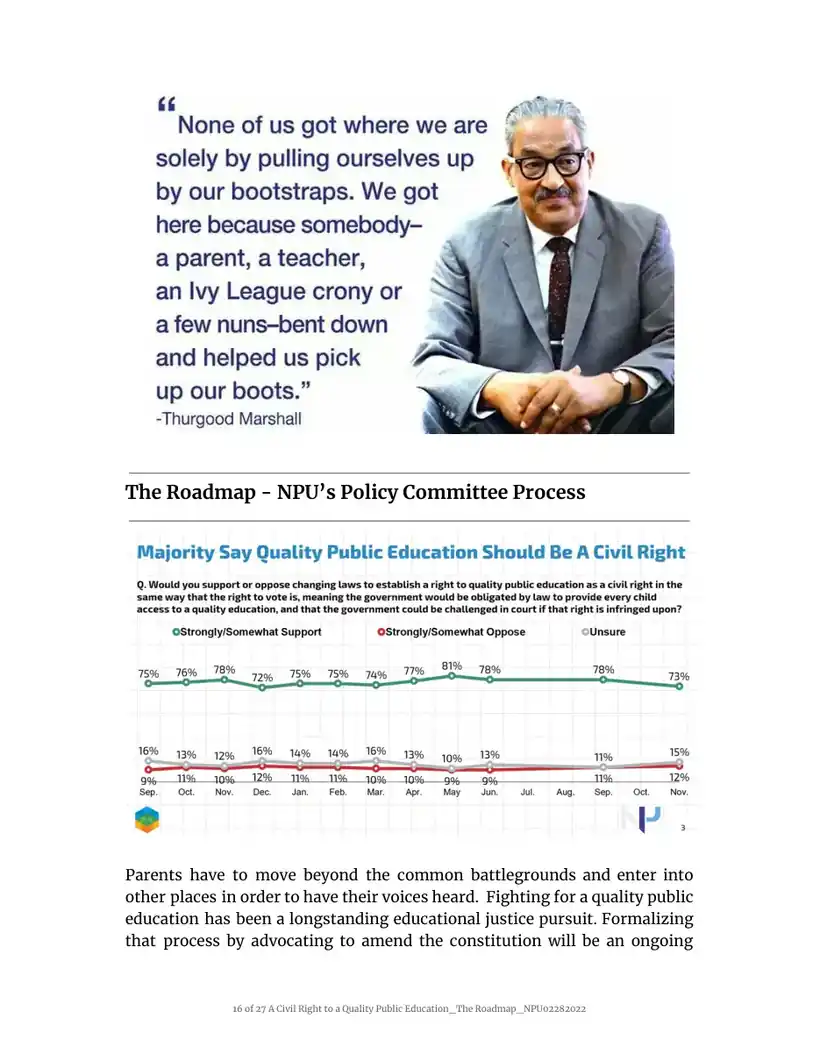
Once we looked at existing laws and established that a fundamental right to a quality education must exist, we began the process of national polling. We discovered over a 9 month period of time from September 2020 to May of 2021, that strong support for a civil right to a quality public education remained consistent. Unequivocally parents support making quality public education a civil right.
While gathering the data, we also met with legal and constitutional experts from Columbia Law School, the University of Virginia School of Law, and private law firms, to frame the right. Looking at this from a national perspective with delegates representing every region, we were able to create a framework to establish a constitutional right in every state and at the diƦerent levels of government. The National Parents Union Policy Committee members met weekly for many months to develop a deep understanding of the law, legal processes and to develop the recommended language. Committee members were mothers and grandmothers from across the United States who made a point of creating language that is inclusive and doesn’t alienate or intimidate parents new to this type of advocacy. The Policy Committee met with legal scholars and lawyers to not only receive feedback on the language but to develop understanding and to anticipate and plan a response for expected push back. The National Parents Union is proud that the authentic voices of parents are included in the finalized draft. The drafts may notreflect oƧcial law, but are based on principles and conditions needed to establish a fundamental or civil right to a quality education. The principles in the language drafts are being used by advocates, and advocacy groups throughout the country as a foundation for legal language in their states.
Our initial draft: A High Quality Public Education as a Civil Right
All public school students who attend schools within the attendance boundaries of LEAs receiving federal funding shall have a legal right to a high quality public education. Any LEA that: (1) generates gaps in learning outcomes between discernable sub-classes of students that it fails to take responsible steps to close; or (2) or in any way subordinates the educational interests of all students — or a discernible subclass of students or schools to other interests, shall be in violation of this statute unless the law, policy, or practice in question is narrowly tailored to achieve a compelling government interest.
This right is intended to codify the natural rights and human rights of all children into legal rights and civil rights. It is intended to build upon and expand the existing legal rights and civil rights of low-income students and students of color beyond their existing rights under the federal or state law to include the right to educational quality available to all on an equal and equitable basis.
Our final proposed language:
Federal Civil Right Proposed format
A-
All public school students who attend schools within the attendance boundaries of LEAs receiving federal funding shall have a legal right to a high quality public education. Any LEA that generates gaps in learning outcomes between discernable sub-classes of students or schools that it fails to take eƦective responsible steps to close, or otherwise subordinates the educational interests of all students, or a discernible subclass of students or schools, to other interests, shall be in violation of this statute unless the law, policy, or practice in question is narrowly tailored to achieve a compelling government interest.
B-
All public school students who attend schools within the attendance boundaries of LEAs receiving federal funding shall have a legal right to a high quality public education. Any LEA that: (1) generates gaps in learning outcomes between discernable sub-classes of students that it fails to take responsible steps to close; or (2) in any way subordinates the educational interests of all students -- or a discernible subclass of students -- to other interests, shall be in violation of this statute unless the law, policy, or practice in question is narrowly tailored to achieve a compelling government interest. This right is intended to codify the natural rights and human rights of all children into legal rights and civil rights. It is intended to build upon and expand the existing legal rights and civil rights of low-income students and students of color beyond their existing rights under the federal or state law to include the right to educational quality available to all on an equal and equitable basis.
This right is intended to expand the legal rights and civil rights of low-income students and students of color beyond their existing rights under the United States Constitution and federal or state law to include the right to educational quality available to all on an equal and equitable basis.
Proposed State civil/constitutional right
A-
All public school students shall have a fundamental right to a high quality public education, triggering strict constitutional scrutiny for any law, regulation, policy, or practice that subjugates the interests of all students, or a discernible subclass of students, to the interests of anon-protected class. This right is intended to codify, expand and protect the natural rights and human rights of all children into legal rights and civil rights. It is intended to expand the constitutional rights and civil rights of low-income students and students of color beyond their existing rights to include the right to educational quality available to all on an equal and equitable basis.
B-
All public school students shall have a legal right to a high quality public education.
Any law, policy, or practice that subjugates the interests of all students, or a discernible subclass of students, to other interests shall be in violation of this statute unless the policy or practice is narrowly tailored to achieve a compelling government interest.
This right is intended to codify the natural rights and human rights of all children into legal rights and civil rights.
It is intended to expand the legal rights and civil rights of low-income students and students of color beyond their existing rights to include the right to educational quality available to all on an equal basis.
Local district-based civil right
All Transitional Kindergarten through 12th grade public school students shall have a legal right to a high quality public education, triggering strict scrutiny of actions that undermine the access of all students, or a discernible subclass of students, to a high quality public education. All public school students within the district attendance boundary shall enjoy all the rights and privileges enumerated under this Act, regardless of race, economic status, disability, religion, national origin, sexual orientation, gender identity, public school model, or immigration status. All district regulations, procedures, policies, practices, board actions, or proposed board actions shall be subject to this right. This right is intended to codify the natural rights and human rights of all children into legal rights and civil rights. It is intended to expand the civil rights of low-income students and students of color beyond their existing rights to include the right to educational quality available to all on an equal basis.
Vetting the language to give parents a framework to legislatively advocate took 12 months. Informing, empowering, and equipping parents by way of training sessions (NPU Week of Action) and toolkits is an important and ongoing process.
Parents are able to learn about their rights or lack thereof and advocate for better. If we are to materialize a fundamental right or civil right to a quality education, parents in every state must form a coalition of parents, activists, legal experts, advocates, community leaders, parent groups, and civil rights organizations to bridge the gap between law, policy, and organizing.
We realize that the legal language will look diƦerent than the drafts we created, however parent advocates will have the tools they need to advocate from a set of guiding principles.
The reason why a coalition is necessary is because oftentimes the opposition when advocating for quality education is fierce. Special interests have historically used their political, social, and financial capital and power against parents in ways that are not fair and keep children bound to failing schools. It would seem highly irrational and unreasonable that these interests work against the interests of children and parents, but the reality is that they do . Parents forging their own way and reclaiming their power over their children’s education is one of the main reasons why the National Parent Union exists.
Conclusion
Parents have been fighting for a seat at the decision making table in all aspects of their children’s education. Unrelenting parents are forced to bring their own chairs to ensure a role in every decision making process for their children because in the end, the consequences we face as a nation for continuing down the path of dismal outcomes for our children will simply lead us to continue down the path of many facing an inability to access economic mobility and a lack of preparation to provide a strong workforce to strengthen our economy, increased, disproportionate rates of incarceration and the continual perpetuation of the existing cycle of poverty. There must be space for them in the key areas of development and progression for their children and our roles should be considered as key stakeholders when it comes to our own children’s education.
Committing to the promise of changing the status quo and education landscape, Parents in partnership with others need to form a strong coalition to demand a high quality public education by any means necessary including remedies in a court of law. It has become clear that changing the education landscape for it to best serve children is not going to come from goodwill or desire within the education system.
Parents must begin advocating to their elected oƧcials, joining in advocacy with national parent and civil rights organizations, partnering with policy strategists and legal experts in order to transform public education through legislation and create accountability in ways that haven't existed before. Instead of reacting to proposed legislation, parents need to be an integral voice in crafting the language that will be presented to legislators and decision makers regarding K-12 Education.
Call to Action - Pursue Education Justice!
K-12 Education is the way society's values are imparted to children and we are at a vital juncture in history. Having a quality education is not only a matter of civil rights but is of the utmost importance to protect human rights. Just like Mendez, Brown, and Rodriguez laid the groundwork, parents must with boldness and audacity martial in a new order of rules about their children’s education and how parent voice is to be valued and respected. For Black, Brown, Indigenous, and poor parents; we must join forces like never before in order to dynamically change the way K-12 Education is reimagined. We cannot aƦord to let this moment go by without fiercely advocating for our children and upcoming generations to have a future and hope.
Glossary of draft terms
Civil Right - guarantees of equal social opportunities and equal protection under the law, regardless of race, religion, or other personal characteristics.5
Codify - To codify means to arrange laws or rules into a systematic code. The process of codification can involve taking judicial decisions or legislative acts and turning them into codified law.6
Fundamental Right - Fundamental rights are a group of rights that have been recognized by the Supreme Court as requiring a high degree of protection from government encroachment. These rights are specifically identified in the Constitution (especially in the Bill of Rights), or have been found under Due Process. Laws encroaching on a fundamental right generally must pass strict scrutiny to be upheld as constitutional.7
LEA - Local Education Agency
Legal Right - Legal rights refers to rights according to law. It exists under the rules of some particular legal system.
Following is a case law defining the term legal right. A legal right is a claim recognizable and enforceable at law. [In re estate of FOLWELL, 68 N.J. Eq. 728, 731 (N.J. 1905)].
The legal right and legal remedy are correlative.8
Narrowly Tailored - Narrow tailoring is the legal principle that a law be written to specifically fulfill only its intended goals. This phrase is most commonly invoked in constitutional law cases in the United States, such as First Amendment cases, or Equal Protection cases involving racial discrimination by creating racial distinctions.9
Strict scrutiny - Strict scrutiny is a form of judicial review that courts use to determine the constitutionality of certain laws. Strict scrutiny is often used by courts when a plaintiƦ sues the government for discrimination. To pass strict scrutiny, the legislature must have passed the law to further a "compelling governmental interest," and must have narrowly tailored the law to achieve that interest.
Strict scrutiny is the highest standard of review which a court will use to evaluate the constitutionality of governmental discrimination. The other two standards are intermediate scrutiny and rational basis review.10
National Parents Union Polling
https://nationalparentsunion.org/category/polling/