Living as a Child in 2026 in the United States
January 2026
INTRODUCTION
Childhood is getting harder as a result of policy failures and a lack of commitment from our nation’s leaders to prioritize kids. As we move into 2026, our kids are struggling with more food insecurity, less access to healthcare, and less resources and oversight within their schools– all while living through a time of great political chaos.
The bell rings, and twenty third-graders drop to the floor.
It is not a game. It is not even rare anymore. Chairs scrape. Sneakers squeak against tile. A teacher counts down to silence because this is what safety sounds like now. Some of these children cannot read the evacuation plan taped to the wall. They are eight years old, practicing how to survive.
Across town, a mother scrolls her phone, waiting for word about an ICE raid rumored to be nearby. In another city, a parent stands in a grocery aisle with a calculator open, deciding what goes back on the shelf so the rent check will clear. At the same moment, a child in another state stares at a screen looping a school shooting video, the algorithm feeding her fear as engagement.
And now, even the fight to prioritize American families has a new competitor: escalation abroad.
On January 3, 2026, the Trump administration launched a U.S. military operation in Venezuela that captured President Nicolás Maduro and removed him to the United States, with President Trump proclaiming the U.S. would “run” Venezuela. The UN human rights office condemned the action as a violation of international law and warned it sets a dangerous precedent.
For parents here at home, that matters for one brutal reason: when the government chooses chaos abroad, they focus even less on the chaos at home. Attention shifts. Resources shift. The news cycle becomes a fog machine. The crises at the kitchen table are told to wait. And when one takeover is treated as normal, the threat of more does not feel theoretical. It feels imminent.
This report exists because families are not confused about what is happening. We are living it.
Every generation tells itself that it loves its children. But love is not measured in sentiment. Love is measured in resources, policies, and choices. And these choices reveal something shattering about who we were becoming. Children were told to be brave while supports were stripped away. Freedom was celebrated while books were banned. Opportunity was promised while the systems that make opportunity possible were weakened. Prices climbed, wages stalled, and instead of urgency, families got mockery from the president of the United States, who brushed off our pain as politics and told us to teach our kids to expect less.
What sounds like talking points in Washington becomes survival math at our kitchen tables.
In real kitchens, parents are skipping meals so children can eat. At pharmacy counters, families are choosing which prescriptions to leave behind and choking on doubling healthcare premiums. In living rooms, we are forced to tell our kids that Santa was on a tight budget and they learned, too early, that money is something to fear. Our hardship is real – but the Administration treats it like a complaint to be silenced instead of a crisis to be solved. The message was clear: we are on our own. And if you cannot keep up, that is your failure, not a political consequence.
The data backs up what families are telling us.
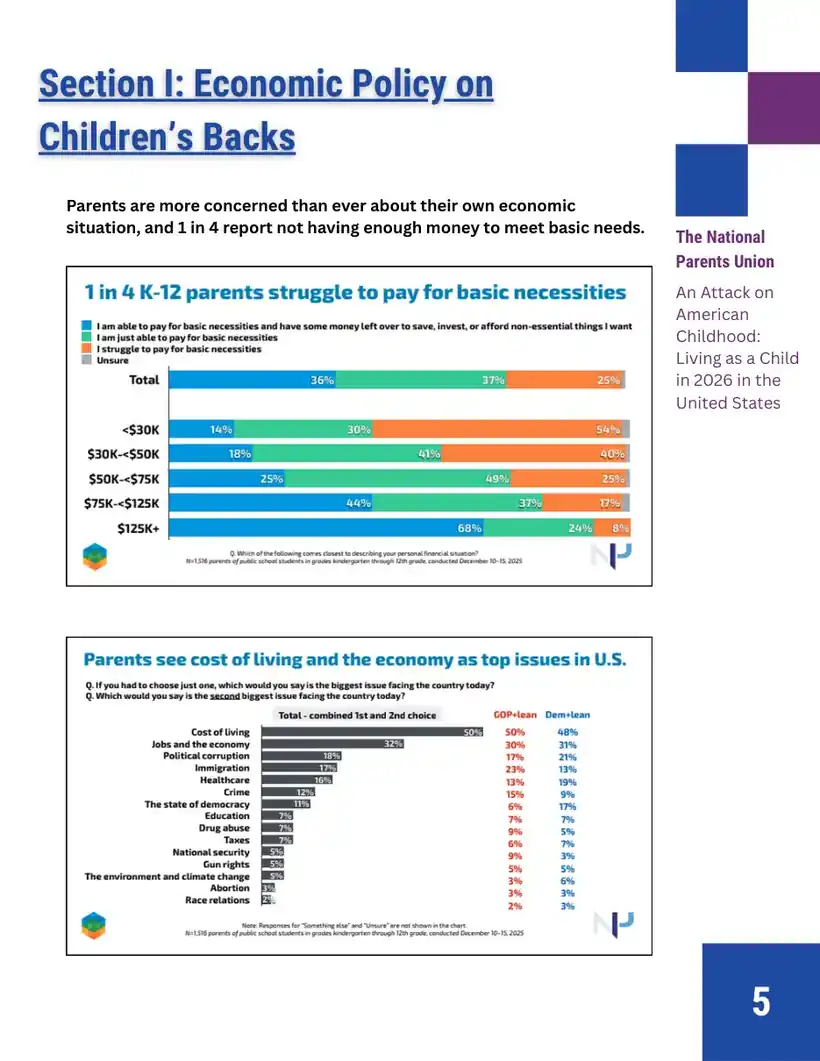
In the National Parents Union’s 2025 End of Year poll, 25% of parents report struggling to pay for basic necessities. Eighty-one percent say rising costs like food and gas are a concern for their family. Fifty-one percent believe economic conditions are getting worse. Sixty-four percent report politics is impacting their child’s education.
Parents are not giving schools a pass, either. A majority (57%) say the K-12 system needs major changes (42%) or a complete overhaul (15%). School safety and school quality remain top concerns. One in five parents report being dissatisfied with the quality of their child’s school–a stark decline from past years.
So let’s say it plainly: as we enter 2026, childhood is becoming a battleground, and children are treated like collateral.
This report traces how it’s happening across four front lines of daily life:
Economic: Families have less buying power, face rising costs in the housing market, stagnant wages and an attack on our social safety nets.
Education: Families are concerned about declining student outcomes, an attack on our national education infrastructure and access to opportunity.
Health: Families have lost healthcare coverage, our public health system is weakening, anti science and anti research guidance threatens best practice and rollbacks to climate guidance threaten air quality.
Safety: Families are concerned about threats of gun violence and threats to communities, as well as the threats to our children’s safety online.
This is not a story of one bad headline or one broken program. It is a story of retreat. Families watched the structures designed to protect children get smaller, slower, weaker, and quieter. Those leading these efforts and those who are complicit by way of silence have left families to fend for themselves. The attack on childhood is not being waged with bombs and barricades. It’s being carried out through omission: silence, neglect, and the slow corrosion of empathy. We aren’t losing childhood overnight. We’re bartering it away, one policy at a time.
This report documents that moral decline: a collapse across so many parts of American life that it’s impossible to rank what matters most. It is also a map for finding our way back.
As you read, we ask one thing: hear these families clearly, and commit to an agenda where our kids are not just surviving, but rising.
Section I: Economic Policy on Children’s Backs
Parents are more concerned than ever about their own economic situation, and 1 in 4 report not having enough money to meet basic needs.
The new economic order did not announce itself with a stock market crash. It showed up in the cereal aisle.
A mom stands in front of the same shelves she has shopped for years and quietly starts putting things back. Strawberries become apples. Name- brand yogurt pouches become store-brand pints. Turkey becomes PB&J. Juice stays on the shelf.
She is not thinking about tariffs or bond markets. She is counting days until payday and guessing which kid will notice that there is no snack this week.
The President brushed off questions about rising prices with a grin. American kids, he said, might have “two dolls instead of thirty dolls” because of his tariffs.
American families and children have lost ground in the economy in the following ways:
1. Family Buying Power: It costs more to shop.
As families conclude the holiday season and enter 2026, they are facing real consequences as a direct result of the Trump administration’s economic policy. Trump trade wars and tariffs have created market volatility, raising prices for imported goods that families rely on as we clothe, feed and support our children.
A large share of fruits and vegetables, nearly all shoes and clothing, and a large portion of school supplies are imported. When tariffs spike, it is not an abstract sacrifice. It is the school shoes that suddenly cost twenty dollars more and the bag of apples that disappears from the cart.
For families who have already cut everything there is to cut, that “small price” is the difference between keeping the lights on and keeping the fridge full. It is the argument at the kitchen table after the kids go to bed. It is another reminder that in this version of America, children’s comfort and security are considered optional features of the economy,
2. Housing prices climb, as income remains the same
Housing tells the same story with fewer metaphors and more eviction notices. Almost 90 percent of families with annual incomes below $20,000 spend more than 30 percent of their incomes on housing expenses—a threshold used by the Department of Housing and Urban Development (HUD) to indicate unaffordability. Sixty percent of families with incomes between $20,000 and $50,000 face the same challenge. Over 6 million Americans are behind on their mortgage payments– the highest number in 20 years.
In 2025, the United States was short more than seven million affordable rental homes for extremely low-income renters. For every hundred families at the bottom of the income ladder, there are roughly thirty-five affordable and available homes. Nearly one in six children live in households behind on rent or mortgage payments, with eviction filings rising in dozens of states. When federal housing funds are cut, those missing homes turn into kids sleeping in cars, motel rooms, shelters, or on somebody’s couch.
Rollbacks of federal rental assistance and homelessness prevention funds have made the problem worse. The 2026 elimination and time limiting of housing vouchers in the new spending package hits children hardest. Those cuts do not show up on cable news as a child emergency alert. They show up as a landlord quietly deciding not to renew a lease, or a notice on the door that rent is increasing beyond what the voucher covers. They show up as a third-grader who transfers schools in the middle of the year, again, and stops raising her hand because nothing feels permanent.
3. Social Safety Nets like food and healthcare assistance are no longer going to catch all our kids.
The One Big Beautiful Bill Act, OBBBA, slashed roughly $186 billion from the Supplemental Nutrition Assistance Program over the next decade. It layers new restrictions on work requirements, reduces federal cost sharing, and shifts administrative burdens to states. On paper, OBBBA “reduces federal spending on nutrition assistance.” In real life, it means a card that suddenly stops working at the grocery store because a form was late, a system crashed, or a worker with a thousand person caseload missed something. State officials and advocates warn that the new rules and cost shifts will leave families without aid for months at a time.
4. Forgotten Geographies: Rural, Native, and Territorial Childhoods
Rural America and Indigenous Communities and Territories have been particularly vulnerable this year– with major cuts to healthcare programs, clean water programs threatened, and Indian Education Services transferred from the Department of Education to the Department of the Interior.
If you listen only to national political coverage, you might think this story belongs mostly to big blue cities and border towns. It does not.
On tribal lands, in rural counties, in Puerto Rico and other territories, the attack on childhood looks like something older: neglect dressed up as austerity.
Native children grow up in communities where promises have been broken for centuries. Chronic underfunding of Indian Health Service clinics, schools run in crumbling buildings, housing shortages, contaminated water, and high rates of poverty and suicide are not new. In 2025, the Trump-Vance administration’s retreat from public health, education, and environmental enforcement hits these communities like a second, quieter wave. When federal support shrinks or stalls, there is no deep local tax base to make up the difference. A Head Start center on a reservation that loses funding does not get replaced by a private preschool. It just vanishes.
Rural children face a different but related reality. Hospitals have closed at alarming rates over the past decade. In some regions, giving birth safely now means driving an hour or more. Mental health providers are scarce. When federal Medicaid dollars shrink and school aid is frozen or diluted, rural districts cannot raise enough local revenue to fill the gap. Teachers leave for better pay and support in suburban districts. Remaining staff double as bus drivers, counselors, and nurses.
Kids in Puerto Rico and other territories have lived through hurricanes, earthquakes, blackouts, and debt crises. Their schools have closed for months at a time. Infrastructure that would never be tolerated in the fifty states remains unrepaired. Yet when federal dollars for housing, schools, and health are cut or delayed, these children are treated as distant afterthoughts.
The administration likes to talk about “real America” in rallies. The real children of rural, Native, and territorial communities see something else: a federal government that remembers them when it needs their land or their labor, and forgets them when it is time to invest in their futures.
None of these policies exist in isolation. Higher rents. Food assistance cuts. The dismantling of school nutrition. Attacks on Medicaid and maternal health. The politicizing of vaccines. The rollback of environmental protections. Each one gets sold as a budget necessity, a freedom issue, a matter of efficiency. Taken together, they tell a single story. That story says: our children will absorb the cost.
Section II: Students Deserve More: Access to Opportunity and The Undermining of the American Education System
Over half of parents report being dissatisfied with the quality of their child’s school and believe that our American Education System needs improvement.
American families and children have lost ground in the education in the following ways:
1. American Student Achievement is Declining
The United States is facing an unprecedented national literacy and numeracy crisis. Seven out of 10 of our nation’s fourth graders are meeting expectations in reading. Of the class of 2024, just 22% were proficient in math and 35% in reading– meaning the majority of the children who graduated from high school last year were not prepared for college or the workforce.
The National Assessment of Educational Progress (NAEP), the Nation’s Report Card, shows reading and math scores stuck at or near their lowest levels in decades. Fourth and eighth graders are still performing worse than they did before COVID. Additionally, the opportunity gap continues to widen; students in the top percentile are making academic progress while those in the bottom 10th percentile are declining rapidly.
On top of that sits a crisis of disengagement. Twenty states report that more than 30 percent of their students missed at least three weeks of school during the 2022–23 year. Chronic absenteeism dropped slightly in 2023–24, but the national rate still hovered around 23.5 percent. That is nearly one in four students missing ten percent or more of the school year.
2. Cuts to Federal Education Programs have left schools and education programming uncertain and without support.
In 2025, the Trump Administration took multiple steps that had a direct impact on kids and schools across the country. From the withholding of $7 billion in federal education funds in the Summer of 2025 to the firings and reductions in programming at the Department of Education, education policy has not centered around quality. Instead, policymakers have prioritized reducing transparency and oversight in order to hide the truth about declining student outcomes.
The dismantling of the Department of Education over the past year has left schools with fewer resources to train their teachers, support vulnerable populations and guarantee access to a free and appropriate public education.
President Trump solidified this education agenda when he tapped Linda McMahon to run the Department of Education– a former pro-wrestling executive who, by her own comments, seemed unaware of basic civil rights history. Her assignment, branded inside the administration as her “final mission,” was simple: shut down the Department and give “education back to the states. ” However. states already run schools. The federal role is small and specific: protect students’ civil rights, set fundamental accountability guardrails, and send extra money to the kids that states have historically ignored.
The Department of Education exists because Congress created it, which means eliminating it would require Congressional action as well. However, in a direct slap in the face to Congress, the Administration has continued to dismantle the Department by issuing an executive order that proclaimed:
“The Secretary of Education shall, to the maximum extent appropriate and permitted by law, take all necessary steps to facilitate the closure of the Department of Education and return authority over education to the States and local communities while ensuring the effective and uninterrupted delivery of services, programs, and benefits on which Americans rely.”
In March 2025, Trump fired 1,350 employees without cause through a Reduction in Force, wiping out nearly half of the Department’s workforce. The Office for Civil Rights (OCR), which investigates discrimination complaints, lost the majority of its staff. Seven regional offices were closed, cutting off families’ direct access to investigators who handle everything from disability accommodations to racial harassment. Complaints related to disability and race are at historic highs while, the capacity to investigate them was intentionally gutted.
The remaining OCR staff were instructed to pause investigations that weren’t aligned with the administration’s priorities, and directed to hunt “woke” districts, chasing anti-DEI cases in order to strip funding from schools with gender neutral bathrooms or programs supporting Black and brown students. The office meant to ensure that every child walks into school with their rights intact was repurposed as an ideological hit squad. Public outrage and lawsuits eventually forced the administration to temporarily reinstate some civil rights staff to handle the backlog.
In July, without warning, the administration froze nearly seven billion dollars from afterschool programs, English learner support, migrant education, and teacher training. Summer school and enrichment programs were cancelled, and low-income districts that already struggle to attract talent were forced into temporary layoffs and hiring freezes Those funds were eventually released, after bipartisan outcry from members of the US Senate and the House of Representatives.
In October, the administration tried again, attempting to leverage a government shutdown to lay off hundreds more employees, including nearly every staff member supporting special education. After enormous pressure, the October layoffs were reversed in a stopgap funding deal. The March terminations were not.
In November, the Department of Education signed a series of inter-agency agreements, shifting key offices out of the Department of Education entirely without Congressional approval. The Office of Elementary and Secondary Education (OESE) and the Office of Postsecondary Education (OPE) were moved to the Department of Labor (DOL).
Rumors swirl about more moves: special education to Health and Human Services as well as the Office of Civil Rights to the Department of Justice. None of those agencies are built to center children or families. None monitor day-to-day school life. The more you chop up the work and send it to offices with different missions, the easier it becomes for every agency in Washington to say, “That is not really our job.” These moves will not only weaken federal oversight. They will create enormous bureaucratic challenges for states and districts trying to access federal funding, who will now have to navigate six separate agencies and grant application systems instead of one.
3. Students with Special Education Supports at Risk
As federal programming continues to be dismantled, it is clear who suffers most: Kids who have to fight school systems to provide them with the learning and opportunity that they deserve.Parents with students with individualised education plans (IEPs) and 504 plans rely heavily on the Department of Education when a school district is not providing services.
The Individuals with Disabilities Education Act (IDEA) is supposed to guarantee that children with disabilities receive a free and appropriate public education in the least restrictive environment, something that often does not happen without federal oversight.
The Secretary of Education has suggested that they move the Office of Special Education Programs to the Department of Health and Human Services- leaving parents of kids with disabilities with no real federal lifeline. This proposed move is widely opposed by parents across the political spectrum.
The proposed changes to federal support for students with disabilities, combined with the large cuts to Medicaid that passed in the Big Beautiful Bill, post a direct threat to special education.
Often understood solely as a health insurance program, Medicaid is one of the largest funding sources for K-12 public schools, providing roughly $7.5 billion per year for essential services for student learning and development. Medicaid covers everything from speech, physical and occupational therapies to specialized medical equipment to transportation. It helps cover the salaries of school nurses and psychologists, as well as many others who work in schools. When the administration cuts Medicaid, and makes enrollment and renewal more difficult, it is not just adults who lose coverage. It is children whose physical therapy sessions are cancelled because the district can no longer bill for the sessions. It is the teenagers who lose access to mental health counseling at a time when we are seeing rising rates of anxiety, depression, and suicidal ideation among students. It is children dependent on school nurses to administer medications.
For disabled children and their families, the combination of underfunded IDEA, gutted enforcement, and fraying Medicaid is not a policy debate. It is a daily triage. It is another way the state tells them: you are on your own.
4. Culture Wars in the Classroom: Politics remain a distraction in classrooms across America.
The fight over education has become a fight over what children are allowed to know about their own country, especially as the United States approaches its 250th birthday in 2026. What should be an opportunity for honest civic reflection is being reshaped into a branding exercise for one narrow vision of patriotism.
In January 2025, President Trump revived the 1776 Commission, an advisory body widely condemned by historians during his first term as error-filled and overtly partisan. Additionally, the Department of Education has started a 50 state bus tour in partnership with right wing group Turning Point USA and other conservative organizations known for attacking belonging in schools.
Now repositioned as an ideological guide for the Semiquincentennial, the commission emphasizes celebration and unity while pushing slavery, dispossession, and the unfinished work of democracy to the margins. The Department of Education followed suit in September 2025, when Secretary McMahon launched the “America 250 Civics Coalition,” partnering with conservative organizations to steer civics programming around “patriotic pride” and “American values.” Through redirected funds, teacher summits, and student contests, the Department is promoting a curated national story that aligns neatly with state laws restricting how educators discuss race, gender, and power. At the same time, state boards are rewriting social studies standards under political pressure—narrowing history, mythologizing civics, and replacing democratic preparation with loyalty tests disguised as multiple-choice exams.
During the 2024–25 school year, there were nearly 7,000 documented instances of book bans across 23 states and 87 school districts, overwhelmingly targeting books about race and civil rights, LGBTQ+ kids and families, gender identity, immigration, and poverty.
Taken together, these moves do not strengthen families or local control. They shift power away from parents and communities and into the hands of those that treat schools as ideological battlegrounds. Teachers spend more time documenting lesson plans, fielding public records requests from out- of-state activists, and defending their own existence than helping students recover academically or prepare for civic life.
Section III: Undermining Public Health
69% of families the rising cost of healthcare is a problem for them.
American families and children have lost ground in receiving care in the following ways:
1. When Coverage Disappears: Families at Risk
Healthcare has been the place where those in power have been willing to take the most from children, making historic cuts to Medicaid and Affordable Care Act subsidies in 2025. Over the next 10 years, as a result of these cuts, an estimated 15 million Americans will lose access to healthcare coverage by 2034 as a result of Congressional actions and inactions this past year. As we enter 2026 and the Affordable Care Act Credits expire, millions of Americans have been left without access to health care coverage.
The Affordable Care Act Tax Credits lowered annual premiums by an average of more than $700 or 44% for those who received them. The ACA credits have been at the center of debate on Capitol Hill as Congressional Republicans chose to enter a record-breaking government shutdown rather than renewing the credits, resulting in 4.2 million Americans losing marketplace coverage.
In rural areas, where hospitals and clinics were already hanging on by a thread, further funding losses have pushed pediatric care toward collapse. When the one pediatrician in a three county radius retires and is never replaced, children do not just lose a doctor. They lose the person who might catch asthma before an ER visit, a vision problem before it becomes a reading crisis, depression before it becomes a tragedy.
2. Anti-Science, Anti-Research Agenda Plagues Federal Policy
This year, we have seen a dramatic shift in Public Health Policy and major changes at the Department of Health and Human Services (HHS), led by Secretary Robert F. Kennedy. Like many other agencies across the Administration, we have seen programming gutted as well as the politicization of what once served as nonpartisan, research-backed guidance.
In 2025, the CDC lost a quarter of its staff as a result of three rounds of reductions in force at the Department of Health and Human Services, chaotic call backs of employees who they begged to rehire and resignations of key leaders in public health.
As a result of losing expertise, HHS has issued guidance that will change the way kids and mothers in our country receive care. This includes scientifically disputed guidance that tylenol is linked to autism, changes to the vaccine schedule, an inadequate response to a historic measles outbreak and the prevalence of a Super Flu as we begin 2026.
Additionally, Florida leadership moved to eliminate school vaccine mandates in the name of parental choice, positioning the state to sever school attendance from standard immunizations. Public health experts called it a “ticking time bomb” and warned of outbreaks of measles, polio, and other controlled diseases. Measles cases quickly tripled. Across the country, hundreds of anti-science bills have surfaced, many written to weaken vaccine requirements, undermine fluoride in drinking water, and chip away at basic public health infrastructure. The federal administration has not only tolerated this trend, but by elevating prominent vaccine skeptics and giving them power over national health policy, it has supercharged it.
3. School Nutrition Programs Cut
In 2024, 21.4 million students received subsidized lunches through the National School Lunch Program. For many students across the country, their school meals are one of the most stable sources of food in their lives. Over the past year, the Department of Agriculture has withheld over $1 billion in funds for the Farm to School Program – a program that allows schools and food banks to purchase from local farms. After significant pushback from the farming community, the USDA released those grants in September but created significant instability for both farmers and food security programs who run on tight budgets with limited flexibility in payment schedules.
Additionally, federal cuts to SNAP-Ed, which funds nutrition education and healthy eating initiatives in schools, have forced multiple states to end programs mid-year.
Meanwhile, the Department of Agriculture has delayed and weakened anticipated nutrition standards for school meals. Efforts to cut sodium and rein in sugary flavored milk have been punted toward 2028. Measures meant to combat childhood obesity are being shelved long enough to reverse more than a decade of progress, and new nutrition guidelines remove recommendations around alcohol consumption and inverted the food pyramid.
4. The First Five Years: Child Care and Maternal Health Under Siege
The attack on childhood does not start at the schoolhouse door. It starts in the delivery room, in the nursery, in the daycare parking lot at six in the morning. This past year, our youngest Americans were faced with the most funding uncertainty, as Head Start became a political bargaining chip. The President has made multiple threats to eliminate the Head Start child care program and has disbanded regional offices. He is currently withholding $10 billion in funding for California, Colorado, Illinois, Minnesota and New York for childcare (Child Care and Development Fund (CCDF)), for Food Funds (Temporary Assistance for Needy Families (TANF)), and for the Social Services Block Grant program – all programs that support our youngest and most vulnerable citizens. During the 2025 Government Shutdown, Head Start Programming was the one of the first programs to be impacted, and the instability of the closures had a lasting impact on the services kids are receiving today.
In addition to creating chaos for our youngest Americans and families through disruptions to childcare, the Trump administration has also proposed cuts to programs that reduce infant mortality. Founded by President George W. Bush, the Healthy Start Program provides programming for prenatal care and services to mothers and infants to reduce both maternal and infant mortality. The Trump Administration proposed the complete elimination of the program in the President’s 2026 budget, although the Senate version of the appropriations bill maintains level funding of the program.
The United States already had one of the highest maternal mortality rates in the developed world, with Black women dying at more than three times the rate of white women. Rather than treating this as a five alarm emergency, the Administration’s cuts to Medicaid and reluctance to secure long term postpartum coverage leave many women without stable care before, during, and after pregnancy.
Infant mortality and low birthweight rates, already higher in poor and marginalized communities, are shaped by this whole environment: food insecurity, lack of prenatal care, exposure to pollution, and constant stress. Yet maternal and infant health investments are treated as optional add-ons rather than core infrastructure.
If you wanted to sabotage a generation before they ever take step foot in a school, you would underfund child care, starve early learning, and leave mothers to navigate pregnancy and postpartum care alone. That is exactly what is happening.
5. Breathing in the Rollback: Climate, Pollution, and Kids’ Health
The attack on childhood is not just happening at the grocery store and clinic. It is in the air kids breathe and the water they drink. This year, the Trump Administration proposed rolling back several regulations related to air quality that will impact kids in the most vulnerable communities.
Children are now coming of age in a climate that is hotter and more hostile than the one their parents knew. Schools in the South and West have heat days where buildings without air conditioning are too hot to safely operate. Districts in the West and Midwest close for wildfire smoke days when the air outside is too toxic for recess, let alone soccer practice. Along the coasts, hurricanes and flooding repeatedly shut schools and displace families.
These disasters are not one-off events. They are the new background conditions of childhood. Kids miss school not just for illness, but because the bus cannot get through flood waters, the classroom is under a tarp, or the air quality index has turned the playground into a hazard.
Environmental injustice makes the damage sharper. Black, Latino, and low income children are more likely to live near highways, warehouses, and industrial sites. They breathe more diesel exhaust and more particulate matter. Asthma rates in these communities are higher and attacks more frequent. Kids show up to school wheezing, or do not show up at all. Families spend nights in emergency rooms for conditions that could have been managed with cleaner air and basic prevention.
Lead, a neurotoxin with no safe level, still lurks in water pipes and peeling paint in older housing and school buildings. Instead of treating lead removal as an urgent national project, environmental rollback means slower timelines and weaker enforcement. What that really means is more children quietly poisoned, more attention and behavior problems blamed on “bad parenting” or “disruptive kids” instead of an environment that literally harmed their brains.
Climate policy debates in Washington often sound abstract: parts per million, emissions targets, compliance deadlines. For children, these choices show up as closed schools, asthma inhalers, days spent indoors, and futures limited by chronic illness. When regulators scrap child specific safeguards and slow walk climate action, they are not just undoing paper rules. They are shortening kids’ breath and narrowing their lives.
Section IV: Childhood in a Permanent State of Emergency
American families and children have lost ground in fundamental safety in the following ways:
1. Lockdown Generation: The New Normal of School Violence
Gun violence is the leading cause of death among American children and teenagers, surpassing motor vehicle accidents years ago. By late 2025, there have been dozens of school shootings.That did not happen because kids suddenly became more reckless. It happened because adults decided that a river of guns is an acceptable price for their political comfort.
Our country has lived through massacre after massacre. The American public has marched, begged, and voted for universal background checks, red flag laws, and limits on weapons that turn classrooms into crime scenes in seconds. Congress has responded by doing almost nothing in response.
The Trump-Vance Administration has gone even further. Instead of building on the fragile progress that existed, it torched it. The White House Office of Gun Violence Prevention, the first national office created to coordinate a serious federal response, was shuttered within hours of the 2025 inauguration. One of the only places in the federal government whose job was to think about keeping our kids alive in school was treated like nothing more than a line in a spreadsheet.
In May, the administration abruptly cancelled roughly one billion dollars in school-based mental health and gun violence prevention grants that Congress had approved. Those dollars were supposed to help schools hire counselors, psychologists, and social workers, and to fund programs that interrupt cycles of violence before they reach the schoolhouse door. At the same time, the Department of Justice eliminated hundreds of grants for community-based violence intervention programs that had been quietly saving lives in neighborhoods politicians rarely visit unless there is crime scene tape and a microphone.
Attempts to enact universal background checks, red flag laws, or assault weapon bans keep stalling. The message is blunt. The government is not going to seriously regulate guns, and it is not going to seriously fund prevention either. Our children will just have to adjust.
So they have.
Almost every public school has drilled students on lockdown procedures. Nearly all have run shelter in place and evacuation drills. This is no longer a temporary shock. It is part of what it means to go to school in America. Survival rituals now sit next to reading and math on the unofficial curriculum.
Five-year-olds learn how to barricade a classroom door with desks and filing cabinets. They learn how to huddle under tables, make their bodies small and quiet, and silence phones. In some drills, teenagers practice sending goodbye texts to their parents. Kindergarteners play new versions of hide and seek that end with a police officer bursting into their classroom with a rifle.
Teachers, already asked to be social workers, nurses, and therapists, now train in trauma medicine. They are shown how to apply pressure to gunshot wounds and improvise tourniquets out of belts. They practice deciding whether to block a door or use their body as a shield. Then they straighten the bulletin board and teach fractions.
All of this is sold as preparation. What it actually produces is a generation entering adolescence with muscle memory for mass casualty events.
Research on lockdown and active shooter drills is catching up to what students have been saying for years. After drills, measures of anxiety and depression jump. Our kids report more trouble sleeping, more stomach aches and headaches, more fear. They startle at loud noises. They rehearse escape routes in their heads instead of listening to the lesson. The drills that were supposed to reassure them confirm the opposite.
The normalization of violence has reshaped the psychology of schooling.
Classrooms that once symbolized safety and opportunity now pulse with tension. Children feel that danger is ever present. Every loud sound can trigger panic. Students report intrusive thoughts, hypervigilance, and trouble concentrating. Some sit in class with one ear tuned for footsteps in the hall and one eye on the door, backs tightened for flight. Concentration becomes a luxury.
The moral toll is just as severe. Sociologist Jonathan Metzal noted, “America has developed emotional calluses around the deaths of its children.” What used to be a national debate has been reduced to a cycle: sirens and breaking news, statements of thoughts and prayers, a few days of outrage, candlelight vigils, then silence. No votes. No new laws. No serious national plan. Just a return to the same baseline where kids practice hiding while adults practice looking away.
To grow up in this era is to absorb the idea that fear is part of education, that walking into school means accepting a level of risk that would be unthinkable in any other wealthy democracy. Parents drop their children off, say “have a good day,” and swallow the thought that this might be the last time. Our kids notice the way their mothers linger in the car line, the way their fathers check their phones during the day.
In this context, inaction is not neutral. It is policy.
The same government that cut food benefits, raised housing insecurity, and dismantled the federal role in protecting students has also chosen to treat gun violence as a culture war issue instead of a public health emergency. Until that changes, until policymakers act as if our children’s right to stay alive in school is more important than an industry’s right to unlimited profit, the drills will continue. So will the funerals.
And just in case school was still the only place a child felt safe, the government made sure to bring fear to the front door too.
2. Raised by the Feed: Childhood in the Age of the Algorithm
After a day of dodging fear in the real world, most kids do what adults trained them to do. They go online.
Nearly all teenagers use social media. The majority are on platforms like YouTube, TikTok, Instagram, and Snapchat, and a large share say they are online almost constantly. Many teens say social media has a mostly negative effect on people their age. That is not because teenagers suddenly became fragile. It is because the digital environment they live in is wired against them.
The platforms that shape childhood are not neutral. They are machines with a single job: keep users on the app as long as possible. The algorithm does not ask whether something is true or healthy for a thirteen year old. It asks whether it will keep them scrolling.
Fear keeps people scrolling. So does outrage, humiliation, and shame. Algorithms push users toward content that provokes the strongest emotional reaction, whether that is curiosity, despair, or horror. When content moderation and safety teams are cut, when “free speech” is weaponized as an excuse to stop enforcing basic standards, those systems are unleashed on children with almost no guardrails. You do not have to look for horror. It comes looking for you.
Children and teens report being shown real time violence, death, self harm, and political extremism in their feeds without asking for any of it. They search for normal things and end up in darker corners. They watch one stressful video and the recommendation engine serves up ten more. What adults call exposure feels like ambient trauma.
The death of a high-profile political commentator on camera showed the country exactly how this works, and how little children matter in the equation.
When Charlie Kirk was killed on video, the footage did not quietly sit on a server. It flooded social media. Millions of users, including minors, watched a man die in front of them, often with no warning label or age gate. Moderation systems tried to catch up, but every time a clip came down, copies popped back up, reuploaded to farm views, followers, and outrage. For days, our kids opened their phones to find death on autoplay.
The platforms took a lesson from that moment. Not a moral one. A commercial one. They learned what holds attention.
For our children, the result is an environment of unrelenting exposure with thin protection. Many are both hyperconnected and profoundly isolated, engaging with the world through screens while disconnected from the people and institutions meant to safeguard them. Tech companies shift the burden of protection away from adults and onto kids themselves. The message is simple: we built this machine to hook you. You are responsible for surviving it.
Into that mess, policymakers have offered one very loud solution: ban phones in school.
On the surface, it sounds reasonable. Parents do not want kids scrolling TikTok during algebra. Teachers are tired of competing with group chats. No one is arguing that a buzzing phone is good pedagogy.
In the current reality, however, blanket bans land as both tone deaf and ineffective.
The same adults who refuse to seriously regulate guns or fund mental health are now telling parents they cannot reach their children during the school day. Families who send kids into buildings where they rehearse active shooter drills, where bullying goes unchecked, where mental health services are thin or nonexistent, are being told their one direct line of contact is a distraction to be confiscated.
Parents do not want their kids doom scrolling in class. They also do not want to spend six hours wondering what is happening inside a school that has already told them, through policy and silence, that it cannot guarantee safety. Kids who are dealing with panic attacks, harassment, self harm, or violence are now expected to navigate all of it without a trusted way to call for help.
Schools are pretending they can fix a twenty-four-hour digital ecosystem with a six-hour prohibition. Phones go into locked pouches at first bell, but the moment kids step off campus, the same unregulated feeds are waiting, more intense than ever. Nothing about the technology changes. Only the adults feel briefly in control.
Worst of all, these bans expose how backwards our priorities are.
We live in a digital economy and are racing toward an AI driven future. Our children will need to understand how technology works, how to build it, how to question it, and how to protect themselves inside it. Classrooms should be the safest place in the country to learn those skills. Instead, many schools are stuck in a fantasy where if they pretend phones do not exist between eight and three, the real world will pause.
We are not updating classrooms to reflect the world our kids actually live in. We are not systematically teaching digital literacy, media analysis, online safety, or healthy habits. We are not giving students real practice in having balanced, intentional relationships with their devices. We are locking the phones away and hoping willpower and punishment can do the job education is supposed to do.
So the responsibility for navigating a billion dollar attention machine gets dropped on eleven year olds.
“Manage your screen time.”
“Curate your feed.”
“Just logoff.”
It is also convenient for the people making money off children’s distress.
There is a simple truth here. These platforms were not built with kids in mind. They were built around a business model that treats every extra minute of attention as profit, no matter what it costs the user on the other side of the glass. When the user is a child, that cost is measured in sleep lost, meals skipped, self worth, body image, attention span, and sometimes their life.
The death of Charlie Kirk was not only a political flashpoint. It was a revealing moment of national priorities. Millions of children and teens watched a man die online, and the country moved on. The algorithms did not pause. They adjusted.
And where is the federal government in all of this? Stuck in the era of dial up.
The last major federal law aimed at protecting children online was written in the late 1990s for a world of static websites–not algorithmic feeds, viral death videos, push notifications, and AI companions. Everything about the digital world has changed. The rules for protecting children have not.
New legislation aimed at requiring platforms to design with minors’ safety in mind and reining in AI companions that target kids has bipartisan support and years of evidence behind it. It is still a proposal, not protection.
Meanwhile, Big Tech moves fast and breaks things. Government moves slowly and breaks nothing, leaving our children to break instead.
The absence of serious regulation is not just a policy gap. It is permission. When lawmakers leave the current system in place, they are telling tech companies: do what you want with our kids.
The pattern is the same as everywhere else in 2026. The digital piece is not separate. It is where everything else lands. The stress from hunger, housing, school, raids, and violence does not disappear when a phone lights up. It shows up in the feed, gets magnified, and gets sold back to kids as content.
Our children’s minds should be treated as critical infrastructure, and schools should teach them how to live in a digital world without being consumed by it. In the United States in 2026, their minds have been handed to systems that see them as data points and revenue streams, and the response has been phone bans instead of real protections and real education.
Once again, the smallest people in the room are carrying the heaviest consequences of the choices adults refuse to make.
3. When Home Stops Feeling Safe: Immigration, Raids, and Family Terror
Communities across the country are under attack as they face threats of ICE raids and violence committed by unidentified, masked agents. These actions are making communities less safe.
On January 7, 2026, Renee Nicole Good, a 37-year-old mother from Minneapolis, was shot and killed by an ICE agent during a federal immigration enforcement operation. Good, a U.S. citizen, had just dropped her six-year-old son at school when the encounter occurred, sparking national outrage and renewed scrutiny of federal immigration tactics.
Across the country, communities report increased fear as ICE activity intensifies — families keeping children home from school, neighbors avoiding public spaces, and local leaders demanding accountability. The killing of Renee Good stands as a grim symbol of the widening gap between public safety and federal enforcement.
Under renewed directives from the Department of Homeland Security (DHS), immigration raids and enforcement operations have surged, sending fear through whole communities. Following heightened immigration enforcement, student absences have spiked, especially among elementary age children. On spreadsheets, the absences look like truancy. In classrooms, they look like something else entirely.
Teachers have seen first graders stop speaking in class. Kids wake up with nightmares and refuse to let go of a parent’s hand at drop off. Older students sit by the classroom door, eyes on the clock, waiting to see if their mother or father will still be there at pickup. The signs match what we recognize as trauma: anxiety, sleep problems, withdrawal, behavior that adults call acting out when the truth is simple. The child is scared.
The administration frames these actions as restoring order and protecting jobs. What families see are early morning raids, unannounced detentions, violence and arrests in public spaces, including outside schools, in neighborhoods and childcare centers. They hear pounding on neighbors’ doors before sunrise. They see parents grabbed while walking kids to class. In that world, the line between safe and dangerous places collapses.
For our children in mixed status households, even a U.S. birth certificate does not feel like a shield. They know their parents can disappear into a system they do not understand. They have watched it happen to classmates and cousins. They learn quickly that citizenship does not guarantee security.
Immigration enforcement has moved far beyond border checkpoints. Sweeping raids target workplaces, neighborhoods, and streets around schools. Helicopters, flash bang grenades, and unmarked vans show up in residential blocks. Our children watch as adults are taken away in tactical gear. They carry that picture into homeroom. You cannot hand that reality to a child and then convincingly tell them school is a safe place to learn.
Inside classrooms, this fear takes familiar shapes. Younger students cling at the door, sobbing at drop off. Some refuse to eat lunch. Others stare through lessons and do not turn in work, not because they do not care, but because they are busy planning what to do if no one is home after school. Teachers try to teach reading while silently wondering who will be missing tomorrow.
The threat of family separation is a form of chronic trauma that interrupts learning and development. That phrase sounds clinical. In practice, it means fear and grief sit in the room during every lesson. Schools with strong policies that protect immigrant families have become de facto sanctuaries, not by federal design but by moral necessity. Where those protections are weak, fear follows children through the door. Kids who should be learning multiplication tables instead memorize hotline numbers in case no adult shows up.
Schools could be buffers against this harm, but we already stripped them of social workers, counselors, and mental health staff. In underfunded schools, educators are left to triage emotional crises without training or resources. Fewer than half say they can effectively provide mental health services to students who need them.
This terror is not confined to immigrant communities. When helicopters rattle the windows of an elementary school, when our kids see armed men in tactical gear on the same sidewalk where they play tag, when their classmate disappears after a raid, that becomes part of the story every child in that building tells themselves about this country. Kids whose families will never face an immigration hearing still absorb the idea that government is something to fear, that some friends’ families can be taken, and that adults in charge can accept this as normal.
The administration insists its strategy is about deterrence and “criminal aliens.” The scale and style of interior raids tell a different story. If this were only about removing people convicted of serious crimes, ICE would not need to park near schools or flood residential blocks with tactical gear. The show of force is the point. It sends a message not only to immigrants but to everyone watching: we can reach you anywhere.
Some state proposals have gone even further, trying to pull schools directly into enforcement. Bills have been introduced to force districts to collect immigration status data on students or penalize schools that support undocumented children, despite longstanding legal precedent that guarantees all children a public education regardless of status. These proposals are not mere policy experiments. They are warnings: your children are visible, and they are not welcome.
For kids who live through this, the impact is not abstract.
When a parent is detained or removed, children experience symptoms consistent with PTSD, depression, and anxiety. They may stop eating, regress in behavior, struggle in school, or become hypervigilant. Caregivers left behind often sink into their own crisis, reporting extreme stress and, in some cases, suicidal thoughts. A single raid can unravel the emotional and economic fabric of an entire block.
Layer poverty on top and everything gets worse. Housing that was barely affordable becomes impossible when a primary earner is taken away. Food insecurity spikes. Kids who were already living with instability now absorb fresh shocks into their bodies and brains. These harms do not show up in ICE press releases. They show up years later in health records, discipline data, and unemployment rates.
Once again, the pattern matches everything else in 2026.
We cut food benefits, then act surprised when children show up hungry and distracted.
We destabilize housing, then pretend to be shocked when absenteeism climbs.
We gut the Department of Education, then feign confusion about why kids are falling behind.
We refuse to regulate guns, then tell children to crouch under their desks.
We militarize immigration enforcement, then act mystified when kids stop believing adults who tell them they are safe.
This is not about border control. It is about using fear as a governing strategy and accepting children as collateral.
In a healthier country, a child’s school and home would be sacred spaces, insulated from political theater and militarized enforcement. In the United States in 2026, those spaces are contested territory. Our kids are learning that the people who claim to be protecting them are often the same people turning their neighborhoods into staging grounds.
The lesson they are absorbing is brutal and simple: the adults knew what this was doing to them and kept doing it anyway.
4. From Classroom to Courtroom: Criminalizing Childhood
Fear does not only walk into schools carrying a rifle. Sometimes it wears a badge and a uniform that is supposedly there to protect kids.
The same decade that normalized lockdown drills also normalized the police officer in the hallway. School resource officers are now fixtures in many middle and high schools, and even some elementary buildings. In theory, they are there for safety. In practice, they often serve as the on-site arm of the criminal legal system.
What used to be handled with a stern talk and a call home can now become an arrest record. A hallway shove turns into an assault charge. A shouted insult becomes disorderly conduct. A kid who scribbles on a bathroom wall is suddenly facing criminal mischief.
This does not fall evenly. Black, Latino, Native, and disabled students are far more likely to be suspended, expelled, or referred to law enforcement for the same behavior as their white peers. In some districts, a Black student with a disability is several times more likely than a white nondisabled student to be arrested at school. That is not because they are more dangerous. It is because the adults have been trained to see them as threats.
The school-to-prison pipeline is not a metaphor. It is a series of decisions. Zero tolerance policies that require suspension for minor infractions. Metal detectors and random bag searches that treat every teenager as a suspect. Memoranda of understanding that invite police into routine discipline. Probation officers and juvenile courts that slap fines and fees on families who are already broke.
Children learn quickly how this works. They learn that if they are loud or frustrated or different, they might get cuffed instead of counseled. They learn that the same state that could have funded afterschool programs or school psychologists chose instead to fund security cameras and officers.
In neighborhoods already flooded with police, the effect is suffocating. Kids move through a world of uniforms: at school, on the street, at home when raids happen. They internalize the idea that public institutions exist primarily to watch, punish, and remove them, not to support them.
When we talk about juvenile justice in this country, we often focus on the end of the pipeline: youth detention centers, juvenile prisons, courtrooms. The attack on childhood is happening much earlier. It is in the classroom where a six year old is handcuffed for a tantrum. It is in the office where a principal calls an officer instead of a parent. It is in the legislature where politicians block funding for counselors and then vote to send more cops into schools.
Fear is being used as a governing strategy, not just through guns and raids, but through the criminalization of normal childhood behavior. And once again, our children on the bottom of the racial and economic ladder are paying the highest price.
Conclusion: Choosing Childhood Again
It should not be this hard to grow up in America. Childhood should be protected by design—buffered from chaos, anchored by stability, and surrounded by systems that exist precisely so our kids do not have to carry the weight of adult failures. As we enter 2026, that protection is fraying. Across kitchens, classrooms, clinics, and communities, our children are feeling the consequences of policy choices made far above their heads and far from their lived reality. Hunger, fear, instability, and silence are creeping into places that should be safe.
This report shows that what families experienced was not a series of unrelated hardships, but a pattern. And these hardships are not just additive; they are duplicative, creating a combined experience of hardship that is far more traumatic than its individual parts. When food assistance is cut, schools are destabilized, healthcare is made unaffordable, and civil rights protections are dismantled, the burden does not fall evenly—it falls on our children first. When federal leadership retreats, families are told to improvise. When cruelty is dressed up as efficiency and indifference as strength, our kids are left to absorb the consequences. That is not resilience. That is abandonment.
But this story does not end with despair. Parents have always been the last line of defense for our children, and in 2026, we are continuing to show up— stretching meals, rationing medication, shielding our kids from fear, and insisting on dignity where the system offers us none. Our voices are not a footnote to this moment; we are its moral center.
America still has a choice. We can continue down a path where childhood is treated as collateral damage in political battles, or we can decide— deliberately—that our children are worth protecting, investing in, and prioritizing. Every generation claims to love its children. The measure of that love is not rhetoric or nostalgia. It is policy. It is budgeting. It is the intentional construction of systems that help families breathe rather than forcing them to brace.
The question before us is not whether this country can afford to put our children first. It is whether we can afford not to.
In 2026, we invite you to join us at the National Parents Union in ensuring that we are making this year the year we put our kids first.