National Parents Union Survey Of K–12 Public School Parents
February 2021
N=1,002 parents of K-12 public school students
February 12–22, 2021
X
Methodology
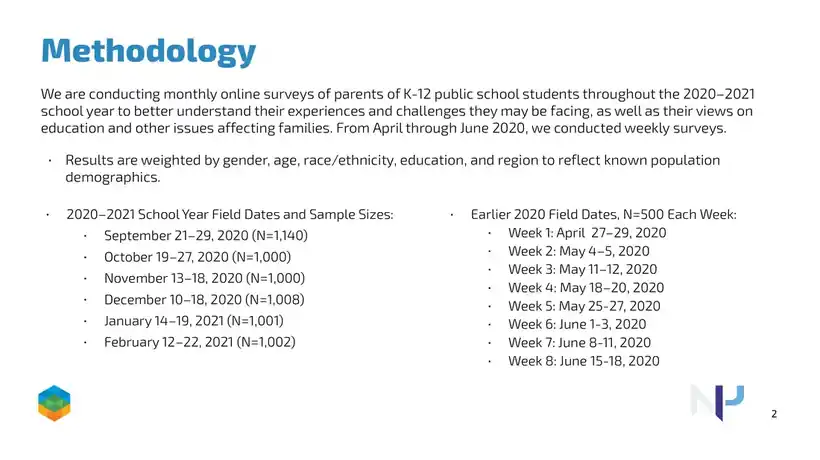
- 2020–2021 School Year Field Dates and Sample Sizes:
- September 21–29, 2020 (N=1,140)
- October 19–27, 2020 (N=1,000)
- November 13–18, 2020 (N=1,000)
- December 10–18, 2020 (N=1,008)
- January 14–19, 2021 (N=1,001)
- February 12–22, 2021 (N=1,002)
- Earlier 2020 Field Dates, N=500 Each Week:
- Week 1: April 27–29, 2020
- Week 2: May 4–5, 2020
- Week 3: May 11–12, 2020
- Week 4: May 18–20, 2020
- Week 5: May 25-27, 2020
- Week 6: June 1-3, 2020
- Week 7: June 8-11, 2020
- Week 8: June 15-18, 2020
We are conducting monthly online surveys of parents of K-12 public school students throughout the 2020–2021 school year to better understand their experiences and challenges they may be facing, as well as their views on education and other issues affecting families. From April through June 2020, we conducted weekly surveys.
• Results are weighted by gender, age, race/ethnicity, education, and region to reflect known population demographics.
Learning During A Pandemic: How It’s Going
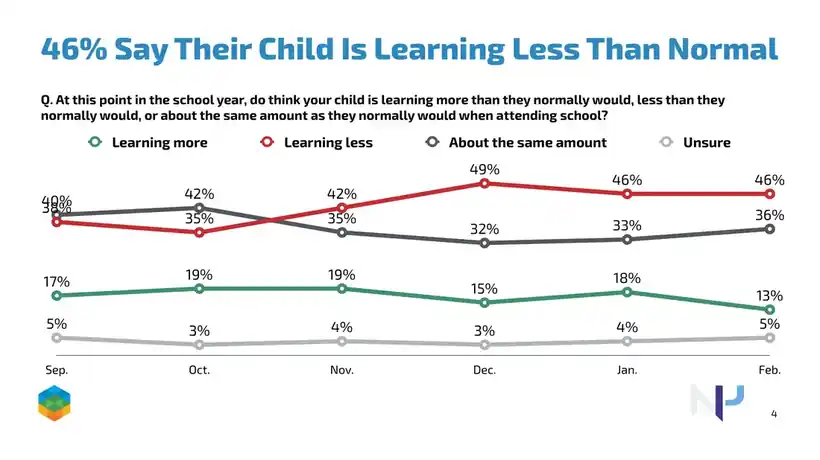
46% Say Their Child Is Learning Less Than Normal
Q. At this point in the school year, do think your child is learning more than they normally would, less than they normally would, or about the same amount as they normally would when attending school?
Learning more Learning less About the same amount
42% 40% 46% 46% 49%
42%
35% 38%
36% 33% 32% 35%
13% 18% 15% 19% 19% 17%
5% 4% 3% 4% 3% 5%
Sep. Oct. Nov. Dec. Jan. Feb.
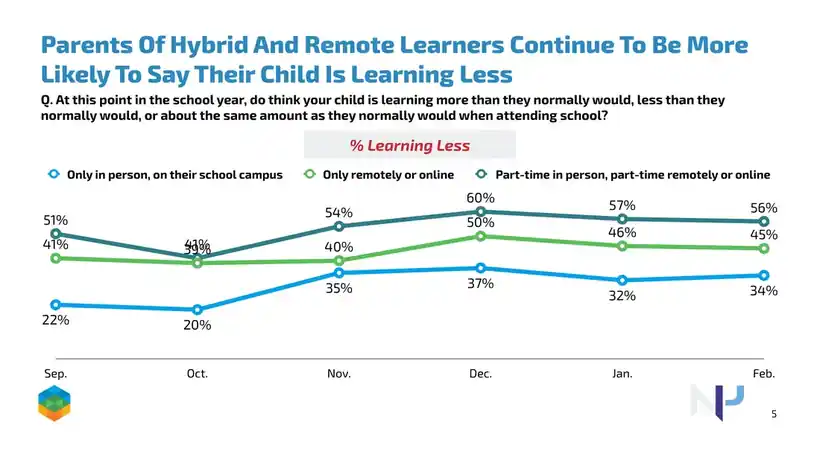
Parents Of Hybrid And Remote Learners Continue To Be More Likely To Say Their Child Is Learning Less
Q. At this point in the school year, do think your child is learning more than they normally would, less than they normally would, or about the same amount as they normally would when attending school?
% Learning Less
Only in person, on their school campus Only remotely or online Part-time in person, part-time remotely or online
56% 57% 60% 54%
51% 45% 46% 50%
40% 39% 41%
41%
34% 32% 37% 35%
20% 22%
Sep. Oct. Nov. Dec. Jan. Feb.
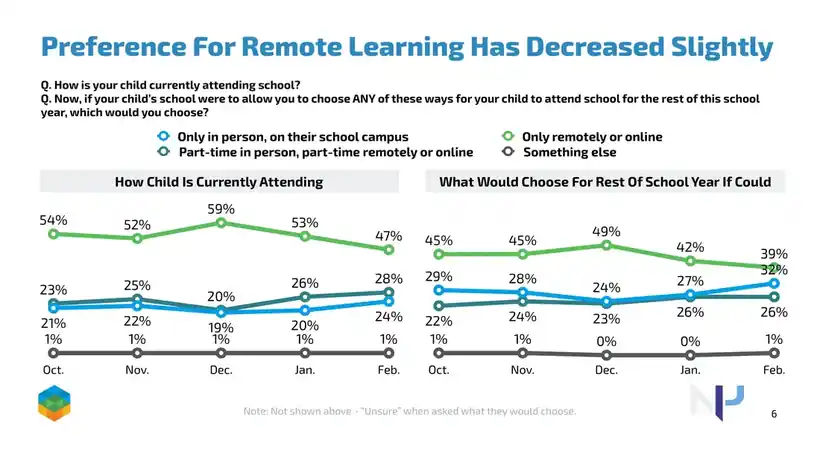
Preference For Remote Learning Has Decreased Slightly
Q. How is your child currently attending school? Q. Now, if your child’s school were to allow you to choose ANY of these ways for your child to attend school for the rest of this school year, which would you choose?
Only in person, on their school campus Only remotely or online Part-time in person, part-time remotely or online Something else
How Child Is Currently Attending
47% 53% 59% 52% 54%
28% 26% 20% 25% 23%
24% 20% 19% 22% 21%
1% 1% 1% 1% 1%
Oct. Nov. Dec. Jan. Feb.
What Would Choose For Rest Of School Year If Could
39% 42% 49% 45% 45%
32% 27% 24% 28% 29%
26% 26% 23% 24% 22%
1% 0% 0% 1% 1%
Oct. Nov. Dec. Jan. Feb.
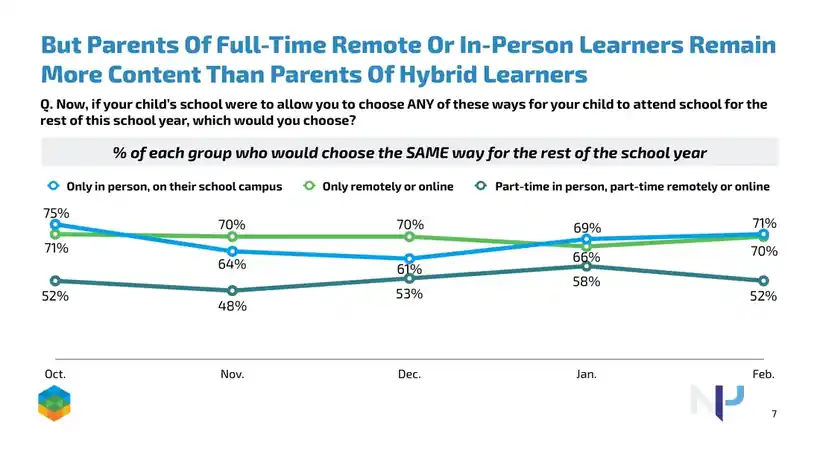
But Parents Of Full-Time Remote Or In-Person Learners Remain More Content Than Parents Of Hybrid Learners
Q. Now, if your child’s school were to allow you to choose ANY of these ways for your child to attend school for the rest of this school year, which would you choose?
% of each group who would choose the SAME way for the rest of the school year
Only in person, on their school campus Only remotely or online Part-time in person, part-time remotely or online
75%
71%
70%
70%
69%
71%
70%
66%
64%
61%
52% 58% 53% 48% 52%
Oct. Nov. Dec. Jan. Feb.
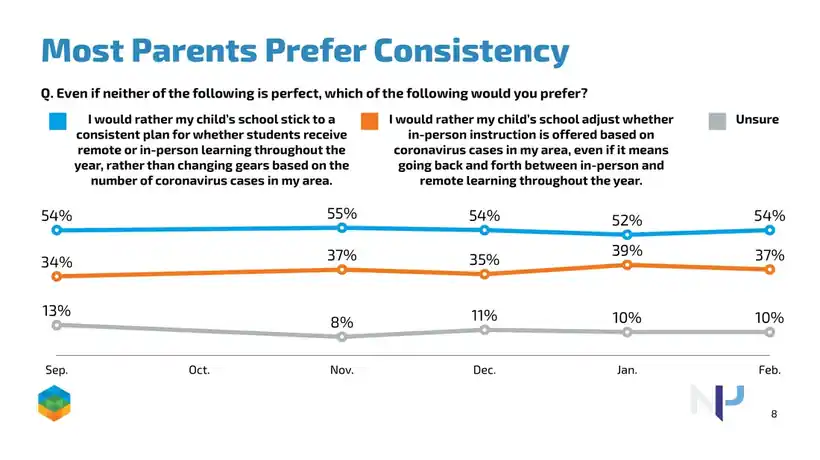
Most Parents Prefer Consistency
Q. Even if neither of the following is perfect, which of the following would you prefer?
I would rather my child’s school stick to a consistent plan for whether students receive
I would rather my child’s school adjust whether
in-person instruction is offered based on coronavirus cases in my area, even if it means
remote or in-person learning throughout the year, rather than changing gears based on the
going back and forth between in-person and
number of coronavirus cases in my area.
remote learning throughout the year.
54% 52% 54% 55% 54%
37% 39% 35% 37% 34%
10% 10% 11% 8% 13%
Sep. Oct. Nov. Dec. Jan. Feb.
Returning To In-Person Learning
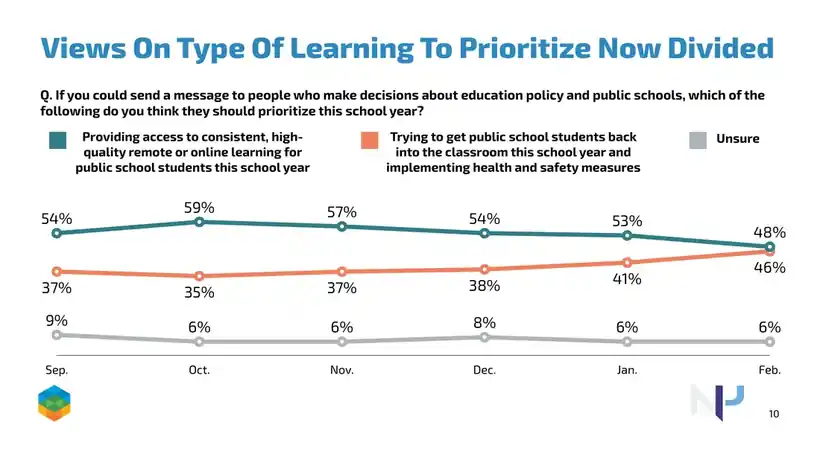
Views On Type Of Learning To Prioritize Now Divided
Q. If you could send a message to people who make decisions about education policy and public schools, which of the following do you think they should prioritize this school year?
Providing access to consistent, high-
Trying to get public school students back
quality remote or online learning for public school students this school year
into the classroom this school year and implementing health and safety measures
48% 53% 54% 57% 59% 54%
46% 41% 38% 37% 35% 37%
6% 6% 8% 6% 6% 9%
Sep. Oct. Nov. Dec. Jan. Feb.
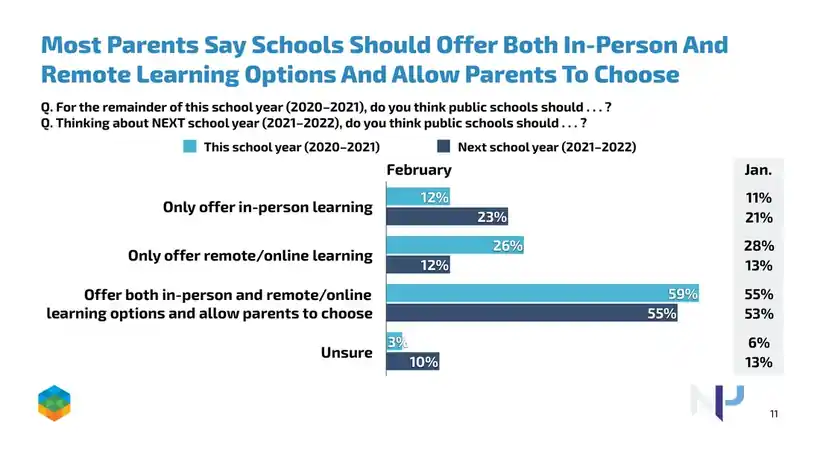
Most Parents Say Schools Should Offer Both In-Person And Remote Learning Options And Allow Parents To Choose
Q. For the remainder of this school year (2020–2021), do you think public schools should . . . ? Q. Thinking about NEXT school year (2021–2022), do you think public schools should . . . ?
This school year (2020–2021) Next school year (2021–2022)
February
Jan.
12%
11% 21%
Only offer in-person learning
23%
26%
28% 13%
Only offer remote/online learning
12%
59%
Offer both in-person and remote/online learning options and allow parents to choose
55% 53%
55%
3%
6% 13%
10%
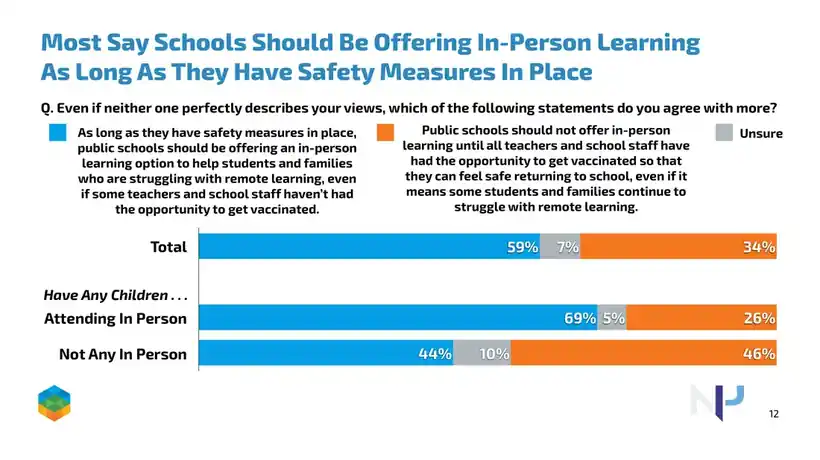
Most Say Schools Should Be Offering In-Person Learning As Long As They Have Safety Measures In Place
Q. Even if neither one perfectly describes your views, which of the following statements do you agree with more?
As long as they have safety measures in place, public schools should be offering an in-person
learning option to help students and families who are struggling with remote learning, even
if some teachers and school staff haven’thad
the opportunity to get vaccinated.
Total
Have Any Children . . .
Attending In Person
Not Any In Person
Public schools should not offer in-person learning until all teachers and school staff have
had the opportunity to get vaccinated so that they can feel safe returning to school, even if it
means some students and families continue to
struggle with remote learning.
34%
7%
59%
26%
5%
69%
46%
10%
44%
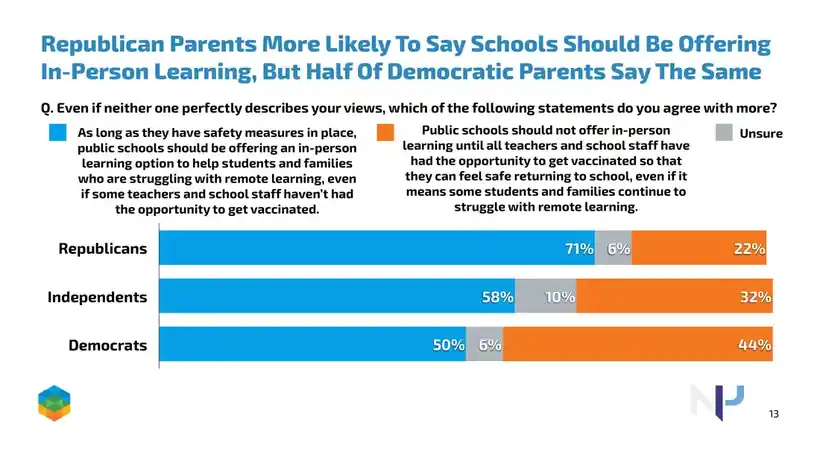
Republican Parents More Likely To Say Schools Should Be Offering In-Person Learning, But Half Of Democratic Parents Say The Same
Q. Even if neither one perfectly describes your views, which of the following statements do you agree with more?
As long as they have safety measures in place, public schools should be offering an in-person
learning option to help students and families who are struggling with remote learning, even
if some teachers and school staff haven’thad
the opportunity to get vaccinated.
Republicans
Independents
Democrats
Public schools should not offer in-person learning until all teachers and school staff have
had the opportunity to get vaccinated so that they can feel safe returning to school, even if it
means some students and families continue to
struggle with remote learning.
22%
6%
71%
32%
10%
58%
44%
6%
50%
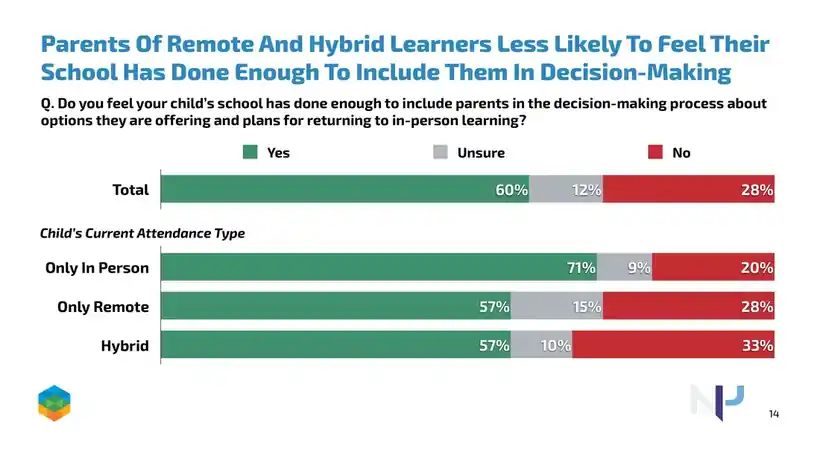
Parents Of Remote And Hybrid Learners Less Likely To Feel Their School Has Done Enough To Include Them In Decision-Making
Q. Do you feel your child’s school has done enough to include parents in the decision-making process about options they are offering and plans for returning to in-person learning?
Yes No
Total
60%
12%
28%
Child’s Current Attendance Type
Only In Person
71%
9%
20%
Only Remote
57%
15%
28%
57%
10%
33%
Hybrid
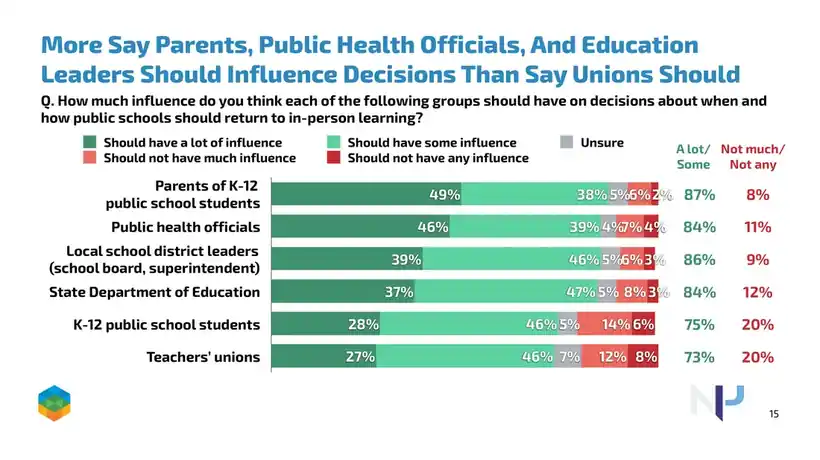
More Say Parents, Public Health Officials, And Education Leaders Should Influence Decisions Than Say Unions Should
Q. How much influence do you think each of the following groups should have on decisions about when and how public schools should return to in-person learning?
Should have a lot of influence Should have some influence Should not have much influence Should not have any influence
A lot/
Not much/
Some
Not any
Parents of K-12 public school students
87% 8%
49%
38%
5%
6%
2%
Public health officials
46%
39%
4%
7%
4%
84% 11%
Local school district leaders (school board, superintendent)
86% 9%
39%
46%
5%
6%
3%
State Department of Education
37%
47%
5%
8%
3%
84% 12%
K-12 public school students
28%
46%
5%
14%
6%
75% 20%
Teachers’ unions
27%
46%
7%
12%
8%
73% 20%
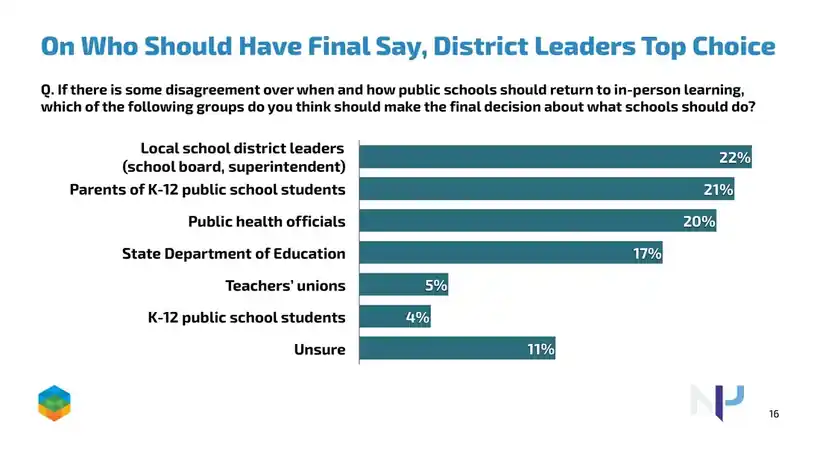
On Who Should Have Final Say, District Leaders Top Choice
Q. If there is some disagreement over when and how public schools should return to in-person learning, which of the following groups do you think should make the final decision about what schools should do?
Local school district leaders (school board, superintendent) Parents of K-12 public school students
Public health officials
State Department of Education
Teachers’ unions
K-12 public school students
22%
21%
20%
17%
5%
4%
11%
Views On Funding Priorities
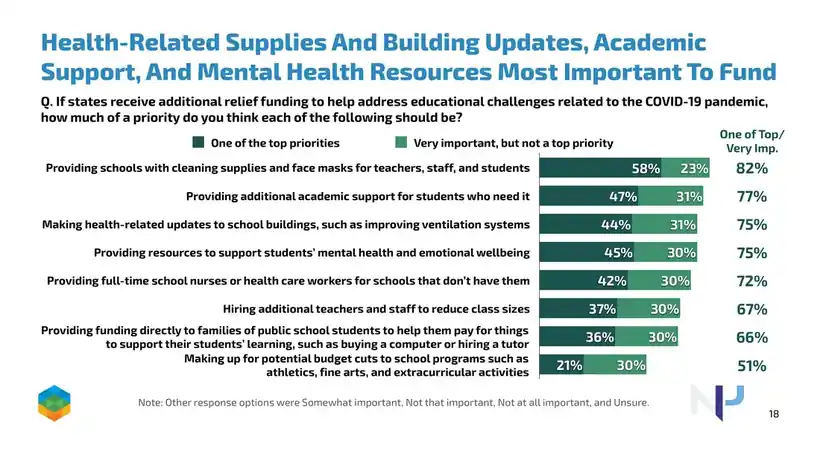
Health-Related Supplies And Building Updates, Academic Support, And Mental Health Resources Most Important To Fund
Q. If states receive additional relief funding to help address educational challenges related to the COVID-19 pandemic, how much of a priority do you think each of the following should be?
One of Top/
One of the top priorities Very important, but not a top priority
Very Imp.
82%
Providing schools with cleaning supplies and face masks for teachers, staff, and students
58%
23%
77%
Providing additional academic support for students who need it
47%
31%
75%
44%
31%
Making health-related updates to school buildings, such as improving ventilation systems
75%
45%
30%
Providing resources to support students’ mental health and emotional wellbeing
72%
42%
30%
Providing full-time school nurses or health care workers for schools that don’t have them
67%
37%
30%
Hiring additional teachers and staff to reduce class sizes
Providing funding directly to families of public school students to help them pay for things to support their students’ learning, such as buying a computer or hiring a tutor
66%
36%
30%
Making up for potential budget cuts to school programs such as athletics, fine arts, and extracurricular activities
51%
21%
30%
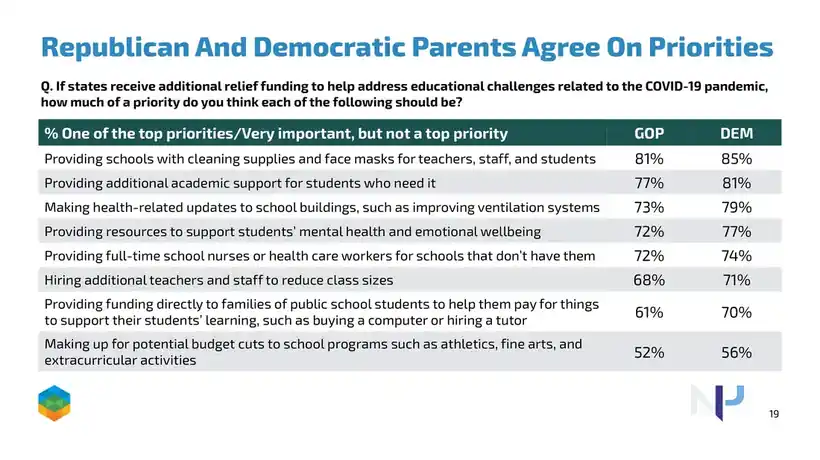
Republican And Democratic Parents Agree On Priorities
Q. If states receive additional relief funding to help address educational challenges related to the COVID-19 pandemic, how much of a priority do you think each of the following should be?
% One of the top priorities/Very important, but not a top priority GOP DEM
Providing schools with cleaning supplies and face masks for teachers, staff, and students 81% 85%
Providing additional academic support for students who need it 77% 81%
Making health-related updates to school buildings, such as improving ventilation systems 73% 79%
Providing resources to support students’ mental health and emotional wellbeing 72% 77%
Providing full-time school nurses or health care workers for schools that don’t have them 72% 74%
Hiring additional teachers and staff to reduce class sizes 68% 71%
Providing funding directly to families of public school students to help them pay for things to support their students’ learning, such as buying a computer or hiring a tutor 61% 70%
Making up for potential budget cuts to school programs such as athletics, fine arts, and extracurricular activities 52% 56%