K-12 SPECIAL EDUCATION ADVOCACY TOOLKIT
K-12 SPECIAL EDUCATION Toolkit
Type of Toolkit: Parent Advocacy NATIONAL PARENTS UNION https://nationalparentsunion.org/
Parents have been fighting for a seat at the decision making table in all aspects of their children’s education. Unrelenting parents like ourselves were forced to bring our own chairs while we ensured a role in every decision making process for our children. While doing that we starkly realized how there was no space for us in the key areas of development and progression for our children. Meanwhile we understood that as parents and families our roles should have been considered as key stakeholders when it came to our children’s education. Committed to the promise of changing the status quo and education landscape, the National Parents Union has partnered with other national organizations and formed a strong coalition to demand a high quality public education by any means necessary. It has become clear that changing the education landscape for it to best serve our children is not going to come from goodwill or desire from within the education system. The National Parents Union is working with elected officials, other national organizations, policy strategists and practitioners to transform public education through legislation and hold accountability.
As a main focal point of centering and solidifying parent voice and crafting proposed education related legislation, the National Parents Union is providing representative delegates, it’s members, and key coalition allies an opportunity to be trained and actively involved in understanding the Special Education process from beginning to end. Equipping major stakeholders like parents, families, and community with the ability to ensure disability rights on a local, statewide and national level empowers them to have a fortified position of authority and control as a strong voice in the K-12 educational landscape.
To support parents, families, and community leaders to know and understand their disability right in the education system, the National Parents Union is offering our training in this SPECIAL EDUCATION toolkit.
1. Purpose The purpose of this toolkit is to establish a clear understanding of a child’s disability rights in K-12 education, recommended an advocacy sequence by which to ensure those rights, and address the quality of education and unique challenges faced by parents of color, low-income parents, special needs parents, single mothers and fathers, grandparents, formerly incarcerated parents and parents in recovery. This toolkit seeks to provide a mechanism for the authentic parent voice to be valued and respected, and also provide resources for NPU delegates and members to champion local, state and federal
action. Herein the National Parents Union will address best expected practices, offer resources and processes pertaining to K-12 education.
2. Background The guarantee and value of a fully funded and high quality special education for children with disabilities has not been fully realized by the local, state, and federal governments and is an age-old problem. Equally the overrepresentation of students according to race and gender who are targeted and identified for special education has plagued our communities, negatively impacting the hope of a future towards a high quality education leading to upward mobility. In order to fully realize the equitable opportunities for a high-quality education that children with disabilities need, remedy the overrepresentation of Black and Brown students misplaced in special education, the true authentic voice of us parents must be respected in all aspects of our children’s educations; including but not limited to major decision-making processes.
We the parents are the most credible source of information regarding our children and their needs, also their primary educators. We should be respected and addressed as key stakeholders in any educational environment. During this time of national pandemic crises, decisions about our children’s education have been made absent our voices and many of our children’s right to quality remediation services and supports have been ignored, compromised, or outright denied.
We understand that the educational landscape has shifted and transitioned in a short time span, however that landscape cannot continue to shift without the inclusion of our beliefs, ideas, demands, voices, and most important of all adherence to the legal mandates of special education. Any educational environment absent our voices is an environment that should be absent from our children.
We have taken extensive steps to create this toolkit, including but not limited to special education training, national polling, daily community education, and active support by disability advocates and funders.
- Scope All key (authentic voice of parents and families) and major stakeholders involved in the educational decision making, special education, disability rights and accountability processes.
4. Definitions and glossary of terms
Student support services which supplement instruction provided in the general curriculum and are designed to assist students in meeting State learning standards. AIS are available to students with special needs and shall be provided consistent with the student's Individualized Education Plan (IEP).
ACADEMIC INTERVENTION SERVICES
Parentified: Academic intervention services help students who are struggling to achieve the learning standards in English language arts and mathematics in grades K-12 and social studies and science in grades 4-12.
ACCOMMODATIONS Changes in the administration of an assessment, such as setting, scheduling, timing, presentation format, response mode, or others, including any combination of these, that do not change the construct intended to be measured by the assessment or the meaning of the resulting scores. Accommodations are used for equity, not advantage, and serve to level the playing field for a student with a disability. To be appropriate, assessment accommodations must be identified in the student’s Individualized Education IEP or Section 504 plan and used regularly during instruction and classroom assessment.
Parentified: an alteration of environment, curriculum format, or equipment that allows an individual with a disability to gain access to content and/or complete assigned tasks.
ACHIEVEMENT TEST An instrument designed to efficiently measure the amount of academic knowledge and/or skill a student has acquired from instruction. Such tests provide information that can be compared to either a norm group or a measure of performance.
Parentified: Achievement tests directly assess students' skill development in academic areas such as reading, math, and written language. They measure the extent to which a student has gained academic knowledge and/or life experiences compared to others of the same age or grade.
ACTIVIST A person who campaigns to bring about political or social change. One who advocates or practices activism : a person who uses or supports strong actions (such as public protests) in support of or opposition to one side of a controversial issue.
Parentified: someone who works to support a cause.
Attention deficit disorder and attention deficit hyperactivity disorder are medical conditions characterized by a child's inability to focus, while possessing impulsivity, fidgeting and inattention.
ATTENTION DEFICIT DISORDER (ADD)
*SEE ADHD
Specially designed physical education program, using accommodations designed to fit the needs of students who require developmental or corrective instruction.
ADAPTIVE PHYSICAL EDUCATION (APE)
ADVOCATE A person who publicly supports or recommends a particular cause or policy. There are three main types of advocacy - self-advocacy, individual advocacy, administrative advocacy, and systems advocacy.
The term self-advocacy, which means speaking up for oneself and one's interests, is used as a name for civil rights movements and mutual aid networks for disabled people. The term arose in the broader civil rights movements of the 1960sand 1970s, and is part of the disability rights movement.
Individual advocacy refers to supporting someone when they need help or trying to find a solution when someone has a problem. You likely advocate for other people often in your daily life, yet you may not think of it as advocacy.
Systems advocacy is focussed on influencing and changing systems—including the legislative, policy and practice aspects of systems. This is done to promote and improve opportunities and outcomes for people with impaired decision-making capacity.
Administrative advocacy involves influencing the rules that government agencies use to implement laws.
Parentified: a person who speaks or writes in support or defense of a person, cause, etc. (usually followed by of): an advocate of peace. a person who pleads for or in behalf of another; intercessor. a person who pleads the cause of another in a court of law
Tests that gather information on the standards-based performance and progress of students whose disabilities preclude their valid and reliable participation in general assessments. Alternate assessments measure the performance of a relatively small population of students who are unable to participate in the general assessment system, with or without accommodations, as determined by the IEP Team. There are different types of alternate assessments a state may adopt under the federal requirements. First, states must make available an alternate assessment based on grade level achievement standards. Then, states may develop two other alternates: the "alternate assessment based on alternate achievement standards" designed for students with the most significant cognitive disabilities and the "alternate assessment based on modified achievement standards" for students who cannot be expected to achieve grade level standards within one school year and who need a less complex assessment to demonstrate their knowledge of those standards.
ALTERNATE ASSESSMENT
Parentified: Alternative assessments are used to determine what students can and cannot do, in contrast to what they do or do not know. Alternative assessments, also referred to as performance tests or authentic assessments, are used to determine what students can and cannot do, in contrast to what they do or do not know
ANNUAL REVIEW An evaluation, conducted at least one time per year, for each child with a disability for the purposes of recommending the continuation, modification or termination of the special education program.
Parentified: The review is a formal meeting required by the federal Individuals With Disabilities Education Act that is conducted by the school for students receiving special education services.
ASSESSMENT The process of collecting information about individuals, groups, or systems that relies upon a number of instruments, one of which may be a test. Therefore, assessment is a more comprehensive term than test.
Parentified: Use multiple sources of information to develop a comprehensive understanding of a student’s strengths and needs.
Any item, piece of equipment, or product system, whether acquired commercially off the shelf, modified, or customized, that is used to increase, maintain, or improve the functional capabilities of a child with a disability. The term does not include a medical device that is surgically implanted, or the replacement of such device [34 CFR §300.5].
ASSISTIVE TECHNOLOGY DEVICE
Parentified: Assistive technology (AT) is any item, piece of equipment, software program, or product system that is used to increase, maintain, or improve the functional capabilities of persons with disabilities.
Any service that directly assists a child with a disability in the selection, acquisition, or use of an assistive technology device [34 CFR §300.6]. It includes evaluation, purchasing, training, and other services related to the acquisition and use of such devices.
ASSISTIVE TECHNOLOGY SERVICE
Attention-deficit/hyperactivity disorder (ADHD) is one of the most common mental disorders affecting children. ADHD also affects many adults. Symptoms of ADHD include inattention (not being able to keep focus), hyperactivity (excess movement that is not fitting to the setting) and impulsivity (hasty acts that occur in the moment without thought).
ATTENTION DEFICIT HYPERACTIVITY DISORDER (ADHD)
A disorder affecting the ability to understand speech.
AUDITORY PROCESSING DISORDER
AUTHORIZER The office or organization that accepts applications, approves, exercises oversight and, after the period of approval, decides on renewal or revocation of a charter school. Some states use different terms for this role, e.g., sponsor.
AUTISM According to the 2006 IDEA regulations 34 CFR §300.8(2)(c): (i) Autism means a developmental disability significantly affecting verbal and nonverbal communication and social interaction, generally evident before age three, that adversely affects a child’s educational performance. Other characteristics often associated with autism are engagement in repetitive activities and stereotyped movements, resistance to environmental change or change in daily routines, and unusual responses to sensory experiences. (ii) Autism does not apply if a child’s educational performance is adversely affected primarily because the child has an emotional disturbance, as defined in paragraph (c)(4) of this section. (iii) A child who manifests the characteristics of autism after age three could be identified as having autism if the criteria in paragraph (c)(1)(i) of this section are satisfied.
A behavior intervention plan (or BIP) is a formal, written plan that teaches and rewards good behavior. The purpose is to prevent or stop misbehavior. BIP is a Special education term used to describe the written plan used to address problem behavior that includes positive behavioral interventions, strategies and support. This may include program modifications and supplementary aids and services.
BEHAVIOR INTERVENTION PLAN (BIP)
A BIP can be a single page or many pages and has three key parts. The plan:
- Lists the problem behavior
- Describes why it’s happening
- Puts in place strategies or supports to help
CHARTER SCHOOLS Charter schools are independent public schools designed and operated by educators, parents, community leaders, educational entrepreneurs, and others. They are authorized/sponsored by designated local or state educational organizations who monitor their quality and effectiveness, but allow them to operate outside of the traditional system of public schools. Most states use the term "charter school" although there are other terms in use for this type of school, such as "community school" used in Ohio and "public school academy" in Michigan.
A child evaluated in accordance with IDEA regulations §§300.304 through 300.311 as having an intellectual disability, a hearing impairment (including deafness), a speech or language impairment, a visual impairment (including blindness), a serious emotional disturbance (referred to in this part as “emotional disturbance”), an orthopedic impairment, autism, traumatic brain injury, another health impairment, a specific learning disability, deaf blindness, or multiple disabilities, and who, by reason thereof, needs special education and related services [34 CFR §300.8(a)(1)]. (See also STUDENT WITH A DISABILITY)
CHILD WITH A DISABILITY
CIVIL RIGHT The rights of citizens to political and social freedom and equality.
The Code of Federal Regulations (CFR) is the codification of the general and permanent rules published in the Federal Register by the executive departments and agencies of the Federal Government. It is divided into 50 titles that represent broad areas subject to Federal regulation. Each volume of the CFR is updated once each calendar year and is issued on a quarterly basis.
CODE OF FEDERAL REGULATIONS (CFR)
COGNITIVE A term that describes the process used for remembering, reasoning, understanding and making decisions.
A committee whose membership includes parents of school children, school personnel and representatives of the public. This committee advises school administration and local school boards regarding the plan for special education, assists with parent education and promotes public awareness of individuals with special needs.
COMMUNITY ADVISORY COMMITTEE (CAC)
A formal complaint filed with the County or State Board of Education if a district violates a legal duty or fails to follow a requirement under the Individuals with Disabilities Education Act (IDEA).
COMPLAINT PROCEDURE
CONSENT The written approval a parent gives to the Committee on Special Education to have their child evaluated and receive services. Consent is always voluntary and a parent may revoke it at any time.
CUMULATIVE FILE The records maintained by the local school district for any child enrolled in school. The file may contain evaluations and information about a child’s disability and placement. It also contains grades and the results of standardized assessments. Parents have the right to inspect these files at any time.
DEAF-BLINDNESS Concomitant (simultaneous) hearing and visual impairments, the combination of which causes such severe communication and other developmental and educational needs that they cannot be accommodated in special education programs solely for children with deafness or children with blindness.
DEAFNESS A hearing impairment so severe that a child is impaired in processing linguistic information through hearing, with or without amplification, and adversely affects a child’s educational performance.
Also called Related Services. Instruction and services not normally provided by regular classes, resource specialist programs or special day classes.
DESIGNATED INSTRUCTIONAL SERVICE (DIS)
There are 16 DIS services available for students:
- Speech and Language
- Occupational and Physical Therapy (OT)
● Adapted Physical Education (APE) ● Hearing Services (HH) ● Interpreting Services ● Vision Services (VI) ● Orientation and Mobility (OM) ● Behavior Intervention Services (ABA) ● Counseling and Guidance ● Parent Counseling and Training ● Psychological Services ● Social Worker Services ● Specially Designed Vocational Education ● Recreation Services ● Heath and Nursing Services ● Mental Health Services ● Counseling/Therapy—Individual, Group & Family ● Parent Counseling and Training ● Psychological Services
Child with a disability for children ages three through nine (or any subset of that age range, including ages three through five), may include a child: (1) Who is experiencing developmental delays, as defined by the state and as measured by appropriate diagnostic instruments and procedures, in one or more of the following areas: physical development, cognitive development, communication development, social or emotional development, or adaptive development; and (2) who, by reason thereof, needs special education and related services [34 CFR §300.8(b)]. In addition: A State that adopts a definition of developmental delay under §300.8(b) determines whether the term applies to children ages three through nine, or to a subset of that age range (e.g., ages three through five). A state may not require an LEA to adopt and use the term developmental delay for any children within its jurisdiction. If an LEA uses the term developmental delay for children described in §300.8(b), the LEA must conform to both the state's definition of that term and to the age range that has been adopted by the state. If a state does not adopt the term developmental delay, an LEA may not independently use that term as a basis for establishing a child’s eligibility under this part [34 CFR §300.111(b)].
DEVELOPMENTAL DELAY
For children from birth to age 3 (under IDEA Part C) and children from ages three through nine (under IDEA Part B), the term developmental delay, as defined by each State, means a delay in one or more of the following areas: physical development, cognitive development, communication, social or emotional development or adaptive [behavioral] development.
Steps or stages of a child’s growth in such skills as sitting, walking and talking. This information is gathered as part of the social history requirements.
DEVELOPMENTAL HISTORY
Diagnostic and Statistical Manual (DSM)is the handbook widely used by clinicians and psychiatrists in the United States to diagnose psychiatric illnesses. Published by the American Psychiatric
DIAGNOSTIC AND STATISTICAL MANUAL (DSM) also (DSM-5)
Association (APA), the DSM covers all categories of mental health disorders for both adults and children.
It contains descriptions, symptoms, and other criteria necessary for diagnosing mental health disorders. It also contains statistics concerning which gender is most affected by the illness, the typical age of onset, the effects of treatment, and common treatment approaches.
The Diagnostic and Statistical Manual of Mental Disorders, Fifth Edition, is the latest 2013 update to the Diagnostic and Statistical Manual of Mental Disorders, the taxonomic and diagnostic tool published by the American Psychiatric Association.
DOMINANT LANGUAGE The language or other mode of communication that the family normally uses. Evaluations of your child are required to be administered in the child’s dominant language.
DUE PROCESS Procedures designed to protect a person’s rights. This includes requirements for confidentiality, consent and complaint mechanisms.
Due process is a formal way to resolve disputes with a school about your child's education. You can file a due process complaint only for special education disputes, not for general education issues. You have the right to an impartial hearing officer and to present evidence and witnesses at the due process hearing.
DYSLEXIA A learning disorder characterized by difficulty reading. A general term for disorders that involve difficulty in learning to read or interpret words, letters, and other symbols, but that do not affect general intelligence.
Dyslexia occurs in children with normal vision and intelligence. Symptoms include late talking, learning new words slowly, and a delay in learning to read.
Types of Dyslexia include BUT not limited to:
● dysphonetic dyslexia ● auditory dyslexia ● dyseidetic dyslexia ● visual dyslexia ● double deficit dyslexia ● attentional dyslexia
A new section of the 2004 reauthorization of the IDEA that provides that an LEA may use not more than 15 percent of the amount the LEA receives under Part B of the IDEA in combination with other amounts (which may include amounts other than education funds) to develop and implement coordinated, early intervening services, which may include interagency financing structures, for students in kindergarten through grade 12 (with a particular emphasis on students in kindergarten through grade three) who are not currently
EARLY INTERVENING SERVICES (EIS)
identified as needing special education or related services, but who need additional academic and behavioral support to succeed in a general education environment [34 CFR §300.226].
Programs and services provided to infants and toddlers under Part C of IDEA who are experiencing developmental delays or have a diagnosed physical or mental condition that has a high probability of resulting in developmental delay.
EARLY INTERVENTION SERVICES
Services intended for students who are not eligible for special education services yet eligible to receive speech and counseling services.
EDUCATIONALLY RELATED SUPPORT SERVICES (ERSS)
A special education emergency contingency plan is intended to provide documentation of special education and related services while a school is physically closed but continuing to provide instruction in the event of an emergency.
EMERGENCY CONTINGENCY PLAN
A condition exhibiting one or more of the following characteristics over a long period of time and to a marked degree that adversely affects a child’s educational performance: (A) An inability to learn that cannot be explained by intellectual, sensory, or health factors. (B) An inability to build or maintain satisfactory interpersonal relationships with peers and teachers. (C) Inappropriate types of behavior or feelings under normal circumstances. (D) A general pervasive mood of unhappiness or depression. (E) A tendency to develop physical symptoms or fears associated with personal or school problems. (ii) Emotional disturbance includes schizophrenia. The term does not apply to children who are socially maladjusted, unless it is determined that they have an emotional disturbance under paragraph (c)(4)(i) of this section [34 CFR §300.8(c)(4)].
EMOTIONAL DISTURBANCE FEDERAL GOVERNMENT
The federal government of the United States is the national government of the United States, a federal republic in North America, composed of 50 states, a federal district, five major self-governing territories and several island possessions. The Federal Government is composed of three distinct branches: legislative, executive, and judicial, whose powers are vested by the U.S. Constitution in the Congress, the President, and the Federal courts, respectively.
Special education and related services that (a) Are provided at public expense, under public supervision and direction, and without charge; (b) Meet the standards of the SEA; (c) Include an appropriate preschool, elementary school, or secondary school education in the state involved; and (d) Are provided in conformity with an individualized IEP that meets the requirements of IDEA §§300.320 through 300.324 [34 CFR §300.17].
FREE APPROPRIATE PUBLIC EDUCATION
A functional behavioral assessment (or FBA) is a process that identifies a specific or target behavior that interferes with a student's education. The assessment attempts to designate the particular behavior, identify the factors that support the behavior, and determine the purpose of the behavior.
FUNCTIONAL BEHAVIORAL ASSESSMENT
HEARING IMPAIRMENT An impairment in hearing, whether permanent or fluctuating, that adversely affects a child’s educational performance but that is not included under the definition of deafness in this section [34 CFR §300.8(c)(5)].
IMPARTIAL HEARING A formal process at which a family’s complaints can be heard by an impartial hearing officer who will resolve the dispute or complaint regarding the child’s evaluation, IEP or certain other issues.
INCLUSION Under special education, an approach that stresses educating students with disabilities, regardless of the type of severity of that disability, in the regular classrooms of their neighborhood schools and delivering special education and related services within the classroom to the extent possible.
A written statement for a child with a disability that is developed, reviewed, and revised in a meeting in accordance with IDEA regulations.
INDIVIDUALIZED EDUCATION PROGRAM (IEP)
The Individualized Education Program (IEP) team consists of education professionals, school personnel, parents, students (age 15 or older), and others who have special knowledge of your child.
INDIVIDUALIZED EDUCATION PROGRAM (IEP) TEAM
Significantly subaverage general intellectual functioning, existing concurrently with deficits in adaptive behavior and manifested during the developmental period, that adversely affects a child’s educational performance [34 CFR §300.8(c)(6); S. 2781 — 111th Congress: Rosa’s Law].
INTELLECTUAL DISABILITY
The IDEA requires that, to the maximum extent appropriate, school districts must educate students with disabilities in the least restrictive environment, i.e., in the regular classroom with appropriate aids and supports (referred to as “supplementary aids and services”) along with their non-disabled peers in the school they would attend if not disabled, unless a student’s IEP requires some other arrangement. See the IDEA regulations at 34CFR §§ 114 through 120.
LEAST RESTRICTIVE ENVIRONMENT (LRE)
LINKAGE The type of connection mandated by state law or voluntarily established between a charter school and a traditional LEA.
LOCAL EDUCATION AGENCY
Local Education Agency - A public board of education or other public authority within a state that maintains administrative control of public elementary or secondary schools in a city, county, township, school district, or other political subdivision of a state. School districts and county offices of education are both LEAs.
A public institution (often referred to as a school district) that has administrative control and direction of one or more public elementary or secondary schools. The term includes a public charter school that is established as an LEA under state law.
LOCAL GOVERNMENT The administration of a particular town, county, or district, with representatives elected by those who live there.
MEDIATION A method for solving a problem that uses persons trained in helping people resolve their own problems. In mediation, the school district and parent will try to reach an agreement with which both parties are satisfied.
MODIFICATION A change to the testing conditions, procedures, and/or formatting so that measurement of the intended construct is no longer valid and the score cannot be aggregated with scores from tests administered under standard conditions.
Multiple disabilities refers to concomitant impairments (such as intellectual disability-blindness or intellectual disability-orthopedic impairment), the combination of which causes such severe educational needs that cannot be accommodated in special education programs solely for one of the impairments. Multiple disabilities do not include deaf-blindness [34 CFR §300.8(c)(7)]
MULTIPLE DISABILITIES NATIONAL PARENTS UNION
A network of highly effective parent organizations and grassroots activists across the country that are united behind a set of common goals and principles to channel the power of parents. Parents of color, low-income parents, special needs parents, single mothers and fathers, grandparents, formerly incarcerated parents and parents in recovery.
OFFICE FOR CIVIL RIGHTS (OCR)
The Office for Civil Rights (OCR) is a sub-agency of the U.S. Department of Education that is primarily focused on enforcing civil rights laws prohibiting schools from engaging in discrimination on the basis of race, color, national origin, sex, disability, age, or membership in patriotic youth organizations.
The section of the U.S. Department of Education responsible for the implementation of the IDEA. It carries out activities related to state eligibility for IDEA funds and monitoring state compliance with IDEA requirements.
OFFICE OF SPECIAL EDUCATION PROGRAMS (OSEP)
A severe orthopedic impairment that adversely affects a child’s educational performance. This includes impairments caused by a congenital anomaly, by disease (e.g., poliomyelitis, bone tuberculosis), and from other causes (e.g., cerebral palsy, amputations, and fractures or burns that cause contractures). [34 CFR §300.8(c)(8)]
ORTHOPEDIC IMPAIRMENT
Having limited strength, vitality, or alertness, including a heightened alertness to environmental stimuli, that results in limited alertness with respect to the educational environment, that (i) Is due to chronic or acute health problems such as asthma, attention deficit disorder or attention deficit hyperactivity disorder, diabetes, epilepsy, a heart condition, hemophilia, lead poisoning, leukemia, nephritis, rheumatic fever, sickle cell anemia, and Tourette syndrome; and (ii) Adversely affects a child’s educational performance [34 CFR §300.8(c)(9)].
OTHER HEALTH IMPAIRMENT (OHI)
Discussion and information-sharing meetings for parents of children with disabilities.
PARENT SUPPORT GROUP
PENDENCY A due process right that the parent and child have that allows the child and family to continue to receive services as described on the current IEP while the parent works to resolve a dispute.
PHYSICAL THERAPY Services provided by a Physical Therapist that relate to large movement difficulties and related functional problems.
QUALIFIED PERSONNEL Under IDEA, personnel who have met SEA-approved or SEA recognized certification, licensing, registration, or other comparable requirements that apply to the area in which the individuals are providing special education or related services.
A reassessment of the child’s ability and achievement within a three-year period. The Individuals with Disabilities Education Act (IDEA) requires schools to reevaluate kids with IEPs at least once every three years. The purpose of the triennial reevaluation is to see if a student's needs have changed.
REEVALUATION REVIEW (may be referred to as Triennial Assessment)
RELATED SERVICES Transportation and such developmental, corrective, and other supportive services as are required to assist a child with a disability to benefit from special education; includes speech-language pathology and audiology services, interpreting services, psychological services, physical and occupational therapy, recreation, including therapeutic recreation, early identification and assessment of disabilities in children, counseling services, including rehabilitation counseling, orientation and mobility services, and medical services for diagnostic or evaluation purposes. Related services also include school health services and school nurse services, social work services in schools, and parent counseling and training [34 CFR §300.34(a)].
A practice of providing high-quality instruction and intervention matched to student needs using data on the child's learning rate and level of performance to make important educational decisions about the necessity for more intense interventions or as part of evaluating eligibility for special education.
RESPONSE TO INTERVENTION (RTI)
Integrates assessment and intervention within a multi-level prevention system to maximize student achievement and to reduce behavioral problems. Schools use data to identify students at risk for poor learning outcomes, monitor student progress, provide evidence-based interventions and adjust the intensity and nature of those interventions depending on a student’s responsiveness, and identify students with learning disabilities or other disabilities. This is similar to Positive Behavioral Interventions and Support (PBIS).
An educational plan or modifications for a student suspected of a disability that may not require special education services.
SECTION 504 ACCOMMODATION PLAN
SPECIAL EDUCATION Specially designed instruction, provided at no cost to the parents, to meet the unique needs of a child with a disability, including (i) Instruction conducted in the classroom, in the home, in hospitals and institutions, and in other settings; and (ii) Instruction in physical education. (2) Special education includes each of the following, if the services otherwise meet the requirements of paragraph (a)(1) of this section: (i) Speech language pathology services, or any other related service, if the service is considered special education rather than a related service under State standards; (ii) Travel training; and (iii) Vocational education [34 CFR §300.39(a)].
A preschool special education teacher who provides direct and indirect service in regular programs or a child’s home for students ages three and four.
SPECIAL EDUCATION ITINERANT TEACHER (SEIT)
A disorder in one or more of the basic psychological processes involved in understanding or in using language, spoken or written, that may manifest itself in an imperfect ability to listen, think, speak, read, write, spell, or to do mathematical calculations, including conditions such as perceptual disabilities, brain injury, minimal brain dysfunction, dyslexia, and developmental aphasia. The term does not include learning problems that are primarily the result of visual, hearing, or motor disabilities, of an intellectual disability, of emotional disturbance, or of environmental, cultural, or economic disadvantage [34 CFR §300.8(c)(10)].
SPECIFIC LEARNING DISABILITY (SLD)
A communication disorder, such as stuttering, impaired articulation, a language impairment, or a voice impairment, that adversely affects a child’s educational performance [34 CFR §300.8(c)(11)].
SPEECH OR LANGUAGE IMPAIRMENT
Services provided by a Speech and Language Pathologist that relate to delays in speech development and communication.
SPEECH THERAPY (SP or ST)
STANDARDIZED TEST A test administered with the same directions and under the same conditions (time limits, etc.) and scored in the same manner for all students to ensure the comparability of scores. Standardization allows reliable and valid comparison to be made among students taking the test. The two major types of standardized tests are norm-referenced and criterion-referenced.
The component of state government primarily responsible for the state supervision of public elementary and secondary schools.
STATE EDUCATION AGENCY (SEA) or STATE EDUCATION DEPARTMENT (SED)
Refers to the state agency that establishes education regulations and provides support to counties and school districts.
STATE GOVERNMENT A state government is the government of a country subdivision in a federal form of government, which shares political power with the federal or national government. ... A state government may have some level of political autonomy or be subject to the direct control of the federal government.
STAY PUT RULE The "stay put" provision states that during the pendency of any due process proceedings, the child shall remain in the then-current educational placement.
The “stay put” provision is one of the most important legal rights in special education law. “Stay put” rights apply when you dispute a change the school wants to make to your child's IEP. When you invoke this right, your child's current placement can remain the same until you and the school resolve the dispute.
In IDEA, defined as “a child evaluated in accordance with §§300.304 through 300.311 as having an intellectual disability, a hearing impairment (including deafness), a speech or language impairment, a visual impairment (including blindness), a serious emotional disturbance (referred to in this part as “emotional disturbance”), an orthopedic impairment, autism, traumatic brain injury, another health impairment, a specific learning disability, deaf blindness, or multiple disabilities, and who, by reason thereof, needs special education and related services.” Section 504 of the Rehabilitation Act of 1973 defines a "handicapped person" (outdated terminology) as "any person who (i) has a physical or mental impairment which substantially limits one or more major life activities, (ii) has a record of such an impairment, or (iii) is regarded as having such an impairment."
STUDENT (CHILD) WITH A DISABILITY
TRANSITION SERVICES A coordinated set of activities for a child with a disability that: (1) Is designed to be within a results-oriented process, that is focused on improving the academic and functional achievement of the child with a disability to facilitate the child’s movement from school to post-school activities, including postsecondary education, vocational education, integrated employment (including supported employment), continuing and adult education, adult services, independent living, or community participation; (2) Is based on the individual child’s needs, taking into account the child’s strengths, preferences, and interests; and includes (i) Instruction; (ii) Related services; (iii) Community experiences; (iv) The development of employment and other post-school adult living objectives; and (v) If appropriate, acquisition of daily living skills and provision of a functional vocational evaluation. Transition services for children with disabilities may be special education, if provided as specially designed instruction, or a related service, if required to assist a child with a disability to benefit from special education [34 CFR §300.43]. Under the section on the IEP, the IDEA law also provides that: Beginning not later than the first IEP to be in effect when the child turns 16, or younger if determined appropriate by the IEP Team, and updated annually, thereafter, the IEP must include (1) Appropriate measurable postsecondary goals based upon age-appropriate transition assessments related to training, education, employment, and, where appropriate, independent living skills; and (2) The transition services (including courses of study) needed to assist the child in reaching those goals [34 CFR §300.320(a)(7)(b)].
*Beginning no later than a student’s 16th birthday (and younger, if appropriate), the IEP must contain transition-related plans designed to help the student prepare for life after secondary school.
An acquired injury to the brain caused by an external physical force, resulting in total or partial functional disability or psychosocial impairment, or both, that adversely affects a child’s educational performance. Traumatic brain injury applies to open or closed head injuries resulting in impairments in one or more areas, such as cognition; language; memory; attention; reasoning; abstract thinking; judgment; problem solving; sensory, perceptual, and motor abilities; psychosocial behavior; physical functions; information processing; and speech. Traumatic brain injury does not apply to brain injuries that are congenital or degenerative, or to brain injuries induced by birth trauma [34 CFR §300.8(c)(12)].
TRAUMATIC BRAIN INJURY
An impairment in vision that, even with correction, adversely affects a child’s educational performance. The term includes both partial sight and blindness. [34 CFR §300.8(c)(13)].
VISUAL IMPAIRMENT INCLUDING BLINDNESS
5. Included in this toolkit ●5.1 Understanding the Special Education Process ●5.2 What to expect as your child transitions through K-12 ●5.3 Dyslexia resources ●5.4 Templates and sample letters ●5.5 Commonly used abbreviations and acronyms ●5.6 Additional resources
6. Additional resources Title Link
National Parents Union https://nationalparentsunion.org/
Link to find elected official based on zipcode https://www.house.gov/representatives/find-your-representati ve https://www.usa.gov/elected-officials Bolder Advocacy https://bolderadvocacy.org/
Freedom of Information Act (please check your local governments laws for public records requests)
https://www.foia.gov/faq.html#:~:text=Since%201967%2C%20 the%20Freedom%20of,the%20know%20about%20their%20go vernment.
Every Family Votes Campaign https://nationalparentsunion.org/every-family-votes-campaig n/
Federal Civil Rights Act of 1964 https://www.dol.gov/agencies/oasam/civil-rights-center/statut es/civil-rights-act-of-1964#:~:text=In%201964%2C%20Congr ess%20passed%20Public,hiring%2C%20promoting%2C%20an d%20firing.
https://www.eeoc.gov/statutes/title-vii-civil-rights-act-1964
Free online Dyslexia Screener https://www.lexercise.com/tests/dyslexia-test?utm_source=bin g&utm_medium=cpc&utm_content=&utm_campaign=Dyslexia %20Test%20Main&utm_term=dyslexia%20screening
Elementary and Secondary Education Act of 1965 ESEA https://www2.ed.gov/documents/essa-act-of-1965.pdf
IDEA, FAPE, ADA and federal section 504 http://www.ldonline.org/article/6086/ https://www.understood.org/en/school-learning/your-childs-ri ghts/basics-about-childs-rights/what-is-and-isnt-covered-un der-fape https://www2.ed.gov/about/offices/list/ocr/docs/edlite-FAPE50 4.html
US Codes https://uscode.house.gov/
KIDS HEALTH https://kidshealth.org/
Dyslexia pertinent laws and information https://dyslexia.yale.edu/resources/accommodations/understan ding-the-law/ https://www.understood.org/en/school-learning/your-childs-ri ghts/basics-about-childs-rights/dyslexia-laws-what-they-are -and-how-they-work https://www.fulcrum-oakland.org/
Students Rights https://www.aclu.org/know-your-rights/students-rights/
What is School Choice? https://www.edchoice.org/school-choice/what-is-school-choic e/
NAEP - National Assessment of Educational Progress https://nces.ed.gov/nationsreportcard/about/covid19.aspx
ADVOCATE AND ACTIVIST https://edtrust.org/the-equity-line/educational-justice-which- are-you-an-advocate-ally-or-activist/ https://www.psychiatry.org/
American Psychiatric Association https://www.archives.gov/federal-register/cfr/about.html
Federal Register > Code of Federal Regulations https://www.parentcenterhub.org/
Center for Parent Information Resources https://www.qualitycharters.org/
National Association of Charter School Authorizers https://www.copaa.org/
Council of Parent Attorneys and Advocates
Disability Rights Advocates https://dralegal.org/ https://www.aclu.org/
American Civil Liberties Union (ACLU)
https://lawyers.law.cornell.edu/
Cornell Law School Legal Information Institute lawyer directory https://www2.ed.gov/about/offices/list/ocr/disabilityoverview.h tml
U.S. Department of Education Office for Civil Rights (OCR) Disability Discrimination https://www.hhs.gov/civil-rights/for-individuals/disability/ind ex.html
U.S. Department of Health and Human Services Office for Civil Rights (HHS OCR) Disability Discrimination https://www.justice.gov/crt/disability-rights-section
The United States Department of Justice Civil Rights Division - Disability Rights https://www.ada.gov/cguide.htm
A Guide to Disability Rights Laws https://pediatrics.aappublications.org/council_on_children_wi th_disabilities
Council on Children with Disabilities https://www.myschoolmyrights.com/complaint-ocr/
HOW TO FILE A COMPLAINT WITH THE OFFICE OF CIVIL RIGHTS
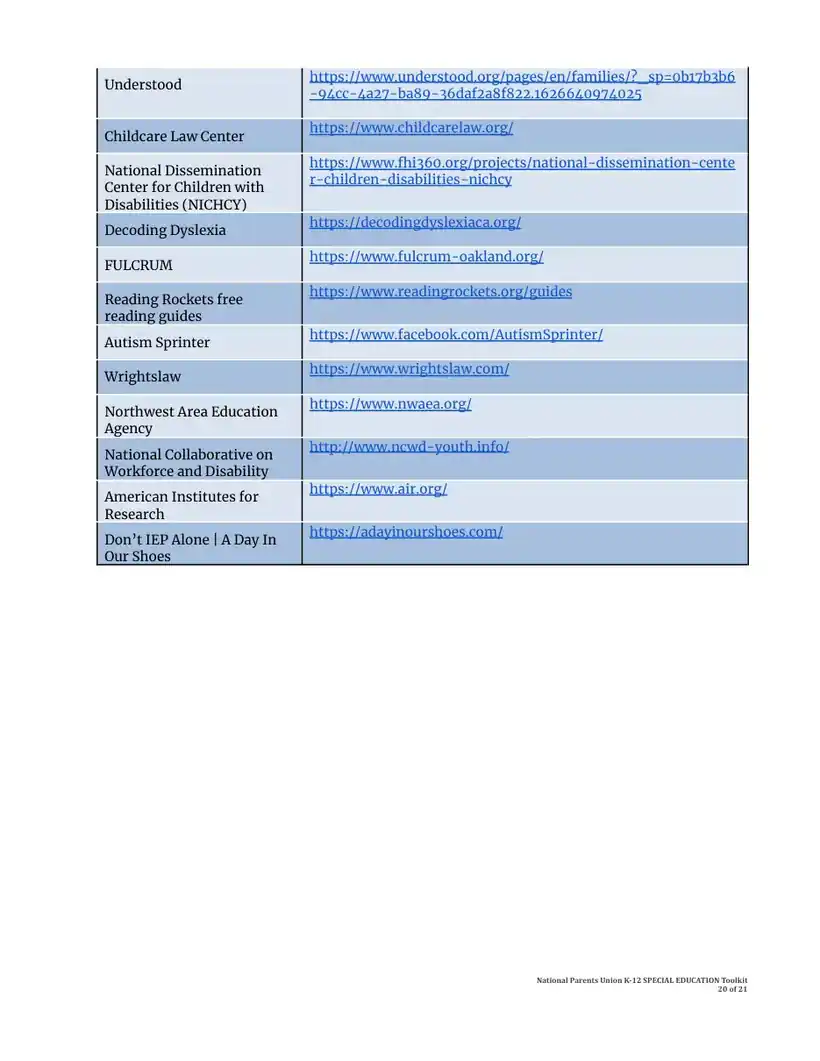
Understood https://www.understood.org/pages/en/families/?_sp=0b17b3b6 -94cc-4a27-ba89-36daf2a8f822.1626640974025
Childcare Law Center https://www.childcarelaw.org/ https://www.fhi360.org/projects/national-dissemination-cente r-children-disabilities-nichcy
National Dissemination Center for Children with Disabilities (NICHCY)
Decoding Dyslexia https://decodingdyslexiaca.org/
FULCRUM https://www.fulcrum-oakland.org/ https://www.readingrockets.org/guides
Reading Rockets free reading guides
Autism Sprinter https://www.facebook.com/AutismSprinter/
Wrightslaw https://www.wrightslaw.com/ https://www.nwaea.org/
Northwest Area Education Agency http://www.ncwd-youth.info/
National Collaborative on Workforce and Disability https://www.air.org/
American Institutes for Research https://adayinourshoes.com/
Don’t IEP Alone | A Day In Our Shoes
7. Toolkit History Revision Date
07-18-2021 Christina Laster Director of Policy & Legislation
08-04-2022 Christina Laster Director of Policy & Legislation
Toolkit created
Toolkit updated and revised
Author Description