CRITICAL CONDITION:
A National Parents Union Special Report, September 2023
FOREWARD
ASHARA BAKER NPU New York State Director ashara@npunion.org
SEPTEMBER 5, 2023
New York families are worried about our children’s future. Our students are currently further behind academically than their peers across New England. As we teach them to read, write and do math, we grow more and more concerned about what life might be like for them in 10-15 years as they try to enter the workforce and find themselves ill-prepared for the jobs of the future.
As parents, we know better than to simply point out a problem without coming to the table to help find real solutions. The National Parents Union - New York, in partnership with families across the Big 5 school districts, including Buffalo, Rochester, Syracuse, Albany, and NYC convened a powerful group of experts and parents monthly across the state to talk about ways to improve student math skills. We stood shoulder to shoulder with the dyslexia community for universal screening and continued literacy improvement to ensure students across our state have a right to read. And we won’t rest until we make it a reality.
New York has taken several important first steps, including improving curriculum and setting professional development standards for educators to be trained on the science of reading.
But there is more work to be done, and the time to move forward is now.
I invite you to join us at the National Parents Union - New York in the fight for excellent, equitable education for all kids. Sign up for our mailing list to get updates as we advocate for kids during this year’s legislative sessions and in districts across the state. Our students are depending on your leadership.
Onward to a bright future,
Ashara Baker
INTRODUCTION
Long-standing inequities exist in our education system and were exacerbated by the COVID-19 pandemic. Now, more than ever, these inequities are threatening the futures of generations of New York kids.
NY Student Achievement Data for Grades 3 to 8
The National Parents Union - New York conducted research and held a series of meetings to better understand how New York Schools are serving our kids. We know what is needed to improve New York schools and provide more opportunities for families and their students to succeed.
The brilliance of our children is clearly evident, yet in many cases, not enough has been done for us to fully realize their potential. But a different future is possible and must be possible. With an eye on concrete outcomes for student progress and the will to make the changes necessary, we believe that New York can improve education for our kids and continue being a global economic and innovation leader well into the future.
COVID-19 hit our students especially hard. Some sources report that students lost as much as 35% of learning during the pandemic.1 Additionally, chronic absenteeism exploded during the pandemic, with 41% of NYC students chronically absent in 2021.2 There was also a spike in mental health challenges and trauma among students, especially among students of color and low-income students.3 And to top it all off, Black students are four times more likely to be suspended in school, which dramatically increased over the pandemic.4
This report acknowledges that New York, under the leadership of Governor Hochul, has made historic investments in education. In this report, we include information about how much additional funding districts have received in covid relief funding and in formula increases.
Resourcing our districts and schools is a first step toward achieving an equitable and excel lent education. This report details relief funding and formula districts received over the last several years.
This report:
1.
Acknowledges the education emergency that is before us. This is a moment we must meet, even if it means getting uncomfortable. The report does not assign blame, but offers opportunities for collaboration.
2.
Provides researched based solutions. Policy recommendations are based on our research and findings, and best practices and tangible results found in other states.
But along with historic investment must come transparency and accountability on delivering meaningful, measurable results. Inconsistent delivery has resulted in an unprecedented crisis as our children fall further and further behind. New York is facing an unprecedented crisis as our students fall further and further behind. In fact, eighth grade students are two years behind their peers in Massachusetts and gaps continue to widen for students across the state.5 If we do not act with urgency, the future of NY State looks different for us all.
STUDENT PERFORMANCE DATA
SCHOOL DISTRICT
SCHOOL DISTRICT
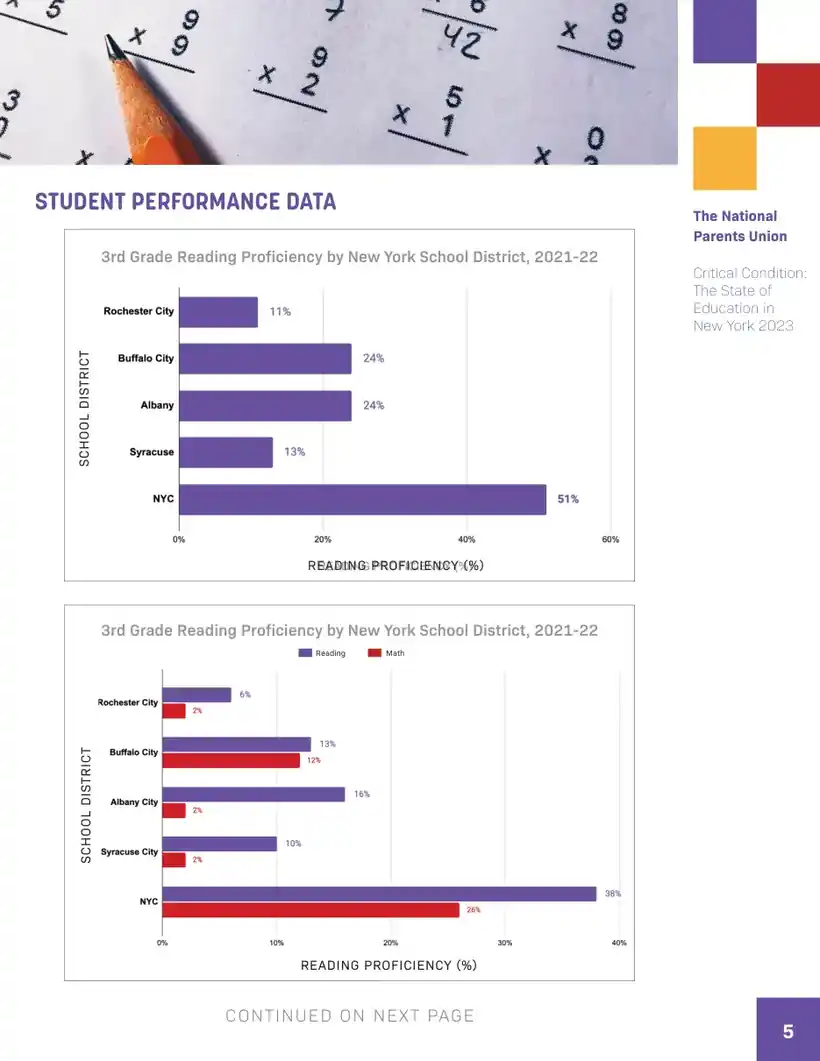
3rd Grade Reading Proficiency by New York School District, 2021-22
READING PROFICIENCY (%)
3rd Grade Reading Proficiency by New York School District, 2021-22
READING PROFICIENCY (%)
STUDENT PERFORMANCE DATA
School District
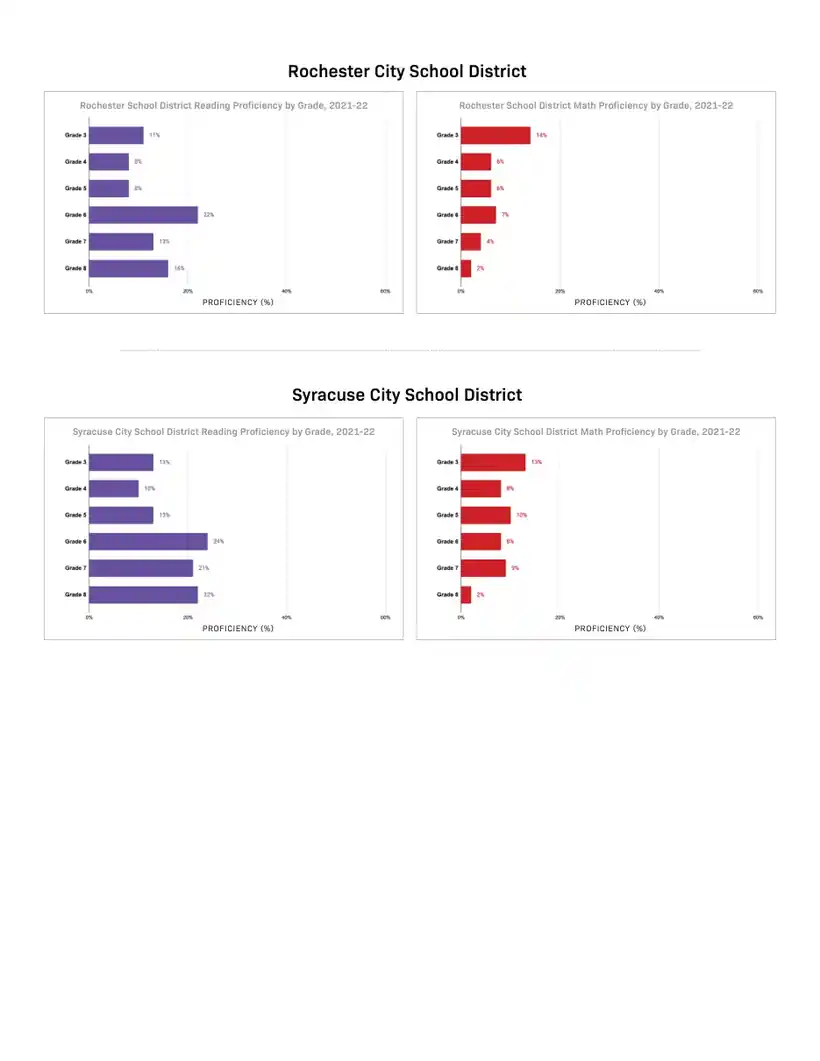
Rochester
Buffalo
City
City
Grade 3: 11%
Grade 3: 24%
Grade 4: 8%
Grade 4: 19%
Reading 2021-2022
Grade 5: 8%
Grade 5: 16%
Grade 6: 22%
Grade 6: 36%
Grade 7: 13%
Grade 7: 22%
Grade 8: 16%
Grade 8: 28%
Grade 3: 14%
Grade 3: 23%
Grade 4: 6%
Grade 4: 15%
Math 2021-2022
Grade 5: 6%
Grade 5: 13%
Grade 6: 7%
Grade 6: 16%
Grade 7: 4%
Grade 7: 11%
Grade 8: 2%
Grade 8: 12%
Albany
Syracuse
New York
City
City
City
Grade 3: 13%
Grade 3: 51%
Grade 4: 10%
Grade 4: 45%
Grade 5: 13%
Grade 5: 40%
Grade 6: 24%
Grade 6: 58%
Grade 7: 21%
Grade 7: 53%
Grade 8: 22%
Grade 8: 55%
Grade 3: 13%
Grade 3: 51%
Grade 4: 8%
Grade 4: 44%
Grade 5: 10%
Grade 5: 38%
Grade 6: 8%
Grade 6: 36%
Grade 7: 9%
Grade 7: 37%
Grade 8: 2%
Grade 8: 26%
Families deserve meaningful, measurable results that prepare our kids for the future. When our kids cannot read on grade level, when they cannot do math on grade level, their future will look incredibly different.
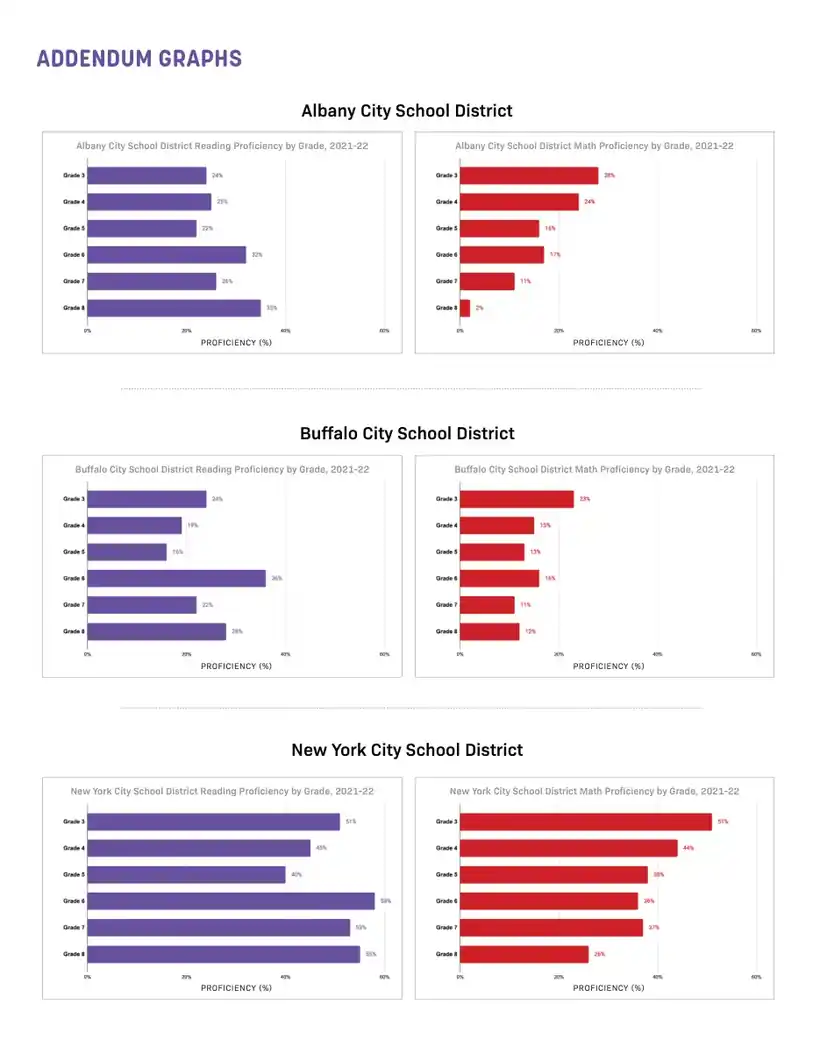
Grade 3: 24%
Grade 4: 25%
Grade 5: 22%
Grade 6: 32%
Grade 7: 26%
Grade 8: 35%
Grade 3: 28%
Grade 4: 24%
Grade 5: 16%
Grade 6: 17%
Grade 7: 11%
Grade 8: 2%
RECORD INCREASES IN FEDERAL STUDENT FUNDING
While student achievement numbers are a reason for grave concern, we are optimistic that districts are well resourced for this upcoming school year to make immediate improvements like adding tutoring programs, as many committed to doing during the development of the Governor’s budget. Additionally, we are seeing school districts like New York City adopt new strategies to teach the science of reading.
We look forward to the district’s reporting on the innovative programs that they used their COVID relief and learning acceleration dollars and on the new programming they are able to develop after Governor Hochul’s historic increase to district budgets.
COVID Relief and Learning Acceleration Dollars:
Overall, $19 Billion has been allocated to New York schools in COVID-19 relief dollars.6 Below is a table that explains the different buckets of federal funds.
ACT7 CARES CRRSA ARP
Date Must Be Spent September 30 2022 September 30 2022 September 30 2022
Amount Allocated $1,037,045,603 $4,002,381,738 $8,995,282,324
Amount Spent as of 7/2023
$1,034,212,184
$2,575,740,378
$2,862,000,795
(99.7%)
(64.4%)
(31.8%)
99.7% spent 64.4% spent 31.8% spent
$1,034,212,184 of CARES Act funds spent
$2,575,740,378 of CRRSA Act funds spent
$2,862,000,795 of ARP Act funds spent
Big 5 School District
Spending on Learning and
Total Funds
Received
Equity
- High Quality Teaching and Learning for All: $16.9M
- Supporting English Language Learners: $660K
Rochester $284,402,878
- Unfinished Learning: $39.9M
- SEL Support: $18.5M
• Enhanced Culturally and Linguistically Responsive Scholar Programming (access to college courses)
Buffalo $289,441,6210
- Expanded Instructional Initiatives: $173M
- Student support services: $38M11
- Social Emotional Supports
- Technology
Albany $31,443,04413
- Academic Support14
- Summer School: $12.1M
- Math Intensive: $21.7M
- Air Quality: $15.2M
Syracuse $157,300,00016
- Reading Intensive: $17.7M
- Attendance Initiatives: $2.3M
- SEL: $1.1 M17
- Fully Funding Schools
NYC $5.7B
- Whole Child
- Expanding Academic Supports20
Ease of Finding Info (1 - 5)
Left to
Spend
( 3 ) Marginally difficult
( 3 ) Marginally difficult
( 2 ) Fairly difficult
( 5 ) Good resources,
$73,000,0019 easy to access
( 3 ) Marginally difficult
Other Spending
- Oracle: $20.8M $152,018,4389
- Technology: (13%) $38M12 Requested
- Air filtration15 Requested
- Technology: $16.6M18
- COVID safety
- Technology21 Requested
Overall, New York State has spent only 46 percent of its COVID relief funds.22 How the remaining 54 percent is spent will have enormous implications for our students today and well into their futures.
HISTORIC INVESTMENTS IN STATE FUNDING
New York Governor Hochul announced historic funding increases for the FY24 budget that will boost educational equity across the state. This includes $24 billion for Foundation Aid—a $2.6 billion increase from last year—to deliver on Governor Hochul’s promise to fully fund Foundation Aid for the first time in history.23
“All New Yorkers deserve access to a high-quality education, from prekindergarten through their college graduation,” Governor Hochul said.24
See table below for a description of state funding increases.
School Aid Increase of $3 Billion, Highest Level of State Aid, Fully Funding Foundation Aid
TYPE OF INCREASE AMOUNT
Increase in Prekindergarten $150M
Expanded Access to Free School Meals $134M
Expands Educational Opportunities with 22 Additional Charter Schools Authorize 22 charters
New Infrastructure and new operating support for SUNY and CUNY — a historic investment in strategic needs
$2,781,000,000
State Matching Fund for SUNY Endowment Contributions $500M
Community Colleges $138M
RESEARCH-BASED SOLUTIONS TO HELP STUDENTS CATCH UP
The National Parents Union - New York supports the National Effort to Support Student Success issued by President Biden on July 5, 2023 and his recommendations for how schools and districts should use their remaining relief dollars.
The recommendations included:
•
High impact tutoring and extended learning opportunities: Kids need extra time beyond the seven hour school day to catch up. Districts across New York should be initiating free tutoring programs for families that employ research-based methods to help students catch up in reading and math.
•
Transparency for parents about student achievement: Parents deserve to know if their student is behind. Schools should report regularly to parents about their students’ progress.Districts and schools should also report their systems’ level progress so that the state can provide supportive interventions to schools that need it most.
•
Provide targeted intervention to districts that need it most: Parents and communities need to be involved in district improvement planning and efforts. This requires trans parency around student progress and what strategies districts are using to help kids catch up.
•
Ground teaching and learning in research: States across the country are making real, observable progress by adopting strategies for teaching and learning the science of reading and math. We applaud curriculum and standards improvements made by the New York State Department of Education this year and look forward to continuing to support programs to enhance the professional development, coaching and support needed to implement curriculum and standard effectively.
CONCLUSION
We, parents across New York, believe that the future of New York students is a bright one — full of big opportunities and limitless potential, but that won’t happen unless we take real and substantive action today.
The State of New York must pass meaningful legislation that holds districts accountable for measurable, meaningful results for kids. This means embracing the science of teaching math and reading — every child should read proficiently by third grade.
Every kid in New York should have their own independent path to opportunity that provides a pathway to economic mobility and clear programmatic goals, interventions and the resources to get them there.
We believe that the future belongs to those who are prepared for it. If we don’t, in 10-15 years, communities across the state will look drastically different and our children and our economy will not be prepared for the changes ahead. We hope that leaders across New York join us in making this upcoming year a year that puts New York kids first.
ACKNOWLEDGEMENTS, FOOTNOTES, AND ADDENDUM GRAPHS TO FOLLOW
ACKNOWLEDGEMENTS
NPU Research Fellow, Addie Letzner, Middlebury College
FOOTNOTES
ADDENDUM GRAPHS
Albany City School District
Buffalo City School District
New York City School District
Rochester City School District
Syracuse City School District